
Table of Contents
- 1. Smart Home Elevator Features: Connected and Convenient
- 2. Glass Elevator Designs for Homes: Style Meets Function
- 3. Touchless and Voice-Activated Elevators: New Appliance Necessities Post-Pandemic
- 4. Trends In Aging-In-Place Elevators: Designing for the Future
- 5. Customization and Luxury Finishes: Personal Style in Movement
- 6. Biophilic Elevator Design: Bringing the Outside In
- 7. Sustainability and Environmentally Friendly Design
- 8. AI-Driven Elevators: The Residential Mobility of the Future
- Conclusion: Elevators that demonstrate a unique lifestyle
The latest design trends in residential elevators focus on sleek aesthetics, panoramic glass cabins, energy efficiency, and compact designs. Nibav Home Elevators USA leads this innovation with air-driven technology, custom color options, and luxury finishes, offering style, safety, and space efficiency for modern American homes.
Residential elevators are not just a convenience when it comes to your home stairs—they reflect luxury, convenience, and modern living. The residential elevators of today can look just as beautiful as they are functional. Modern residential elevators capture the full spectrum of possibilities available to improve their effective function and their overall design perspective.
In this blog, we are going to look at the 8 hottest design trends in the residential elevator market that are making an impact: glass cabins and panoramic views, voice activation, biophilic designs, and elevators with artificial intelligence that optimize the user experience.
1. Smart Home Elevator Features: Connected and Convenient
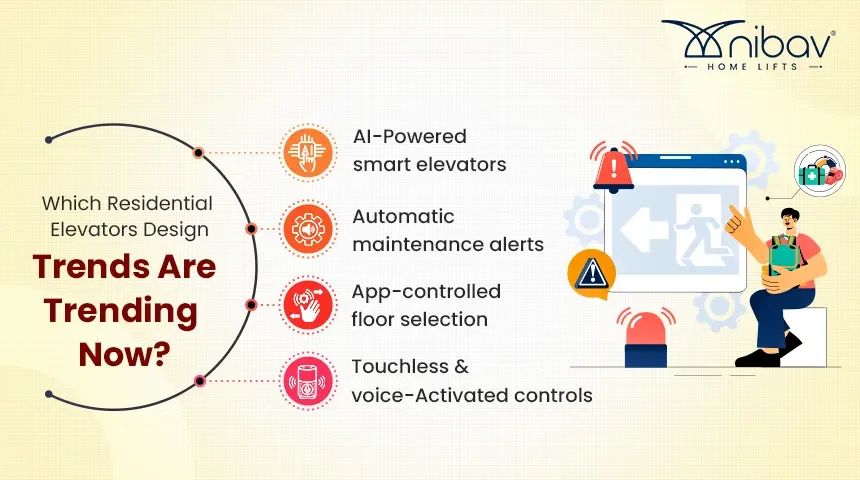
Smart technology features are at the forefront of contemporary elevator design. Today’s consumers desire elevators that communicate with the rest of the home.
- Voice-activated home elevator systems enable users to navigate between floors without utilizing their hands, which is especially convenient when carrying groceries or if any individuals in the home have mobility challenges.
- Touchless elevator controls utilize sensors or mobile applications to navigate between floors, eliminating the need for physical buttons and improving hygiene by minimizing contact.
- IoT-enabled monitoring can control your elevator in real-time, allowing you to receive notifications about maintenance, energy usage, and performance optimization.
These, along with several other smart features, align with the broader narrative of the smart home, where convenience and rapid decisions can be made quickly and safely.
2. Glass Elevator Designs for Homes: Style Meets Function
- Glass elevators are one of the fastest-growing aesthetic trends in residential lifts. They are no longer something exclusive to luxury hotels or high-rise commercial buildings; glass elevators provide a feeling of openness, as well as elegance and style. Sophisticated, panoramic glass cabins increase natural light into stairwells and living spaces.
- Minimalist framing with 360-degree views that expose structural elements drastically change the perception of elevators from practical transportation between floors to modern architectural masterpieces. Homeowners in contemporary villas, penthouses, and waterfront properties in particular appreciate how glass elevators illustrate design without interrupting interior circulation.
This is more than a trend; it’s a sign that elevators are becoming celebrated features instead of hidden utilities.
3. Touchless and Voice-Activated Elevators: New Appliance Necessities Post-Pandemic
- Demand for contactless technology soared during the pandemic, and it seems that residential elevators are no exception.
- Touchless panels use gesture-recognizing proximity sensors or mobile apps to call and operate the lift.
- Voice-activated commands (“take me to the second floor”) bring convenience and accessibility to seniors and users with impaired mobility.
- Touchless and voice-recognizing technologies not only establish hygiene, health, and ease-of-use, but they are now almost essential requirements for new installations.
4. Trends In Aging-In-Place Elevators: Designing for the Future
With an increasing number of homeowners planning to age in place, it is no surprise that elevator designs are becoming more sophisticated by featuring things that support independence as people grow older and/or require assistance.
- Shaftless, low-maintenance designs such as vacuum elevators can integrate seamlessly with smaller homes and do not require a lot of renovations or structural upheaval.
- Elevators with controls that are simple, wide doors, and non-slip flooring can make elevators more friendly for seniors.
- Many newer elevators now even allow for battery backup support so they can still travel in the event of a power outage.
- Elevators not only fulfill mobility requirements, but they also provide long-term value for a home, as they allow a home to adapt with its users.
5. Customization and Luxury Finishes: Personal Style in Movement
Today, elevators can be customized to any design idea. Choose from every finish available in materials—wood paneling, glass, stainless steel, or custom veneers, where applicable.
- Lighting Trends: Ambient LED lighting elevates the overall experience of a ride.
- Luxury Upgrades: whether it is mirrored walls, leather finishes, or the options for making elevators your own private little sanctuary inside your home, there are so many custom-designed options to choose from.
In markets such as the U.S., with luxury homes leading the way in sales of elevators, customization is one of the characteristics separating non-luxury elevator designs from luxury elevator designs.
6. Biophilic Elevator Design: Bringing the Outside In
Though rare, a growing design trend is biophilic design, bringing the natural environment into everyday spaces, including elevators.
- Cabins with living green walls or plant-inspired graphics provide a calming connection to nature during the ride experience.
- Natural wood finishes, lower lighting, and air filtration or purified air grease removal systems all enhance the aspect of being stitched to nature while travelling between floors.
This design trend will definitely appeal to eco-conscious homeowners who want an elevator cabin to feel like an extension of the outside. Constituting a new niche, biophilic elevators present as durable conversation pieces, adding a unique, sustainable twist to luxury design principles.
7. Sustainability and Environmentally Friendly Design
Sustainability and green design are no longer optional, and sustainability is the driving force.
For example, vacuum elevators depend on air pressure rather than using hydraulic oil for lifting, resulting in less maintenance and environmental impact.
- Energy-efficient motors and standby modes reduce electricity consumption.
- Use of eco-certified materials in cab interiors can help align a project with environmental and green building efforts.
There’s a distinct trend focusing on sustainability in the elevator industry, mainly from the USA, where restrictive environmental regulations have forced manufacturers to investigate innovative methodologies for producing and designing with a level of sustainability and environmental stewardship.
8. AI-Driven Elevators: The Residential Mobility of the Future
AI-driven home elevators might still be in their infancy of development possibilities, but developments in how we use lifts and elevators in our homes are not far away.
With the potential for AI in future elevators to learn routines, your elevator could always be at the correct floor in the morning, or it would recognize the peak time of usage and be waiting for you.
In addition, predictive AI monitoring systems might algebraically identify potential maintenance or operational interruptions before they happen, resulting in uptime = zero downtime. Here, we can discuss combining smart home elevators with AI, potentially utilizing voice assistants, security systems, etc.
Although this is not yet a mainstream design trend, it’s possibly the most intriguing residential elevator design trend on the horizon.
Conclusion: Elevators that demonstrate a unique lifestyle
The newest design trends in residential elevators show that elevators are becoming a lifestyle as much as they are practical (in useful and usable order). For instance, glass elevators that illuminate homes with natural light to AI elevators that learn our routines are demonstrating the style choices and liveability considerations that homeowners are trying to achieve through luxurious and sustainable, and meaningful designs in their homes.
For homeowners who are preparing for their next major upgrade, the elevator is not about opportunity for accessibility; accessibility is assumed to be the next elevation of your residential space as a modern, sustainable, and emotional experience that is, elevated design in lifestyle reflects our values.
Get in touch with our home elevator experts now and experience your home with a whole new level of luxury and comfort.
Talk to Our Experts
Hudson
The trend analysis in this blog is excellent. I love how house elevator design can blend luxury with accessibility. Aging-in-place features are becoming more important, and this article explains the benefits clearly. Great resource!
Luca
AI-based predictive maintenance blew my mind. I never thought home elevators would get that advanced. This level of convenience and safety in residential elevator design really reflects modern living. Great write-up!
Elias
I learned so much from this post. Custom color options and modern finishes truly elevate residential glass elevator design. It’s amazing how they can become architectural showpieces. Thanks for sharing design-forward ideas!
Zayden
I found this article extremely helpful as someone exploring house elevator design options. The trend toward panoramic residential glass elevators design is stunning and feels perfect for modern American homes. The mix of style, safety, and technology makes installing a home elevator more exciting than ever.
Caden
Very well-detailed post! I found the section on residential glass elevator design particularly inspiring. The idea of filling my home with natural light through a glass cabin is something I’m now seriously considering. This was a very helpful guide for understanding current elevator trends.
Ayden
The clarity and detail in this article were incredibly helpful. I’ve been researching elevator design for home, and the insights on AI-driven systems were fascinating. It’s exciting to see how elevators are becoming smarter, safer, and more beautiful at the same time.