
Table of Contents
- Points to Consider
- Understanding Your Options
- Ramps
- Residential Elevators
- Ramp Vs Residential Elevator Comparisons
- Make decisions based on your layout of entry
- ADA/Local Building Codes
- Cost & Value Over Time
- Are You Planning to Age in Place?
- When Does a Ramp Make Sense?
- When Does a Residential Elevator Make Sense?
- Why Nibav Lifts USA?
- Frequently Asked Questions
When enhancing the accessibility of your home, particularly at the entryway, ramps and residential elevators are two of the ideal solutions that tend to rise to the top. Ramps have been around for a long time and have certainly stood the test of time, but also readily available today are modern, stylish, and elegant options such as Nibav home elevators that offer ease of use, practicality, and above all else, safety. This write-up aims to cover both options, helping you decide what best suits your lifestyle, space constraints, and long-term vision.
Points to Consider
- Ramps: Cost-effective and practical for low elevations—a great option if you have space for a ramp and are on a budget.
- Residential Elevators – like Nibav products—are a complete game changer for tight spaces and vertical elevation, while offering unlimited options in many functional and stylish designs.
- Always review ADA guidelines in addition to your local codes with regard to slope, landing, accessibility, etc.
- Both the entryway’s layout, rise height, aesthetics, and any plans for long-term mobility will impact your decision.
Understanding Your Options
Ramps
Ramps create a sloped walking surface to replace steady walking, making the entry smooth and effortless—great for a person in a wheelchair or with a rollator, or even for someone who simply prefers to walk up with a gentle incline. They can be either permanent, modular, or portable, but for low-rise elevations, they are very effective.
Residential Elevators
Also known as home elevators, they elevate occupants along a vertical plane in style and ease—generally requiring some civil work. Nibav Lifts, for example, can be retrofitted into an existing home with elegance and also avoid major renovations; they are electric-powered and energy efficient and have the advantages of accessibility, function, and overall design to create a harmonious environment.
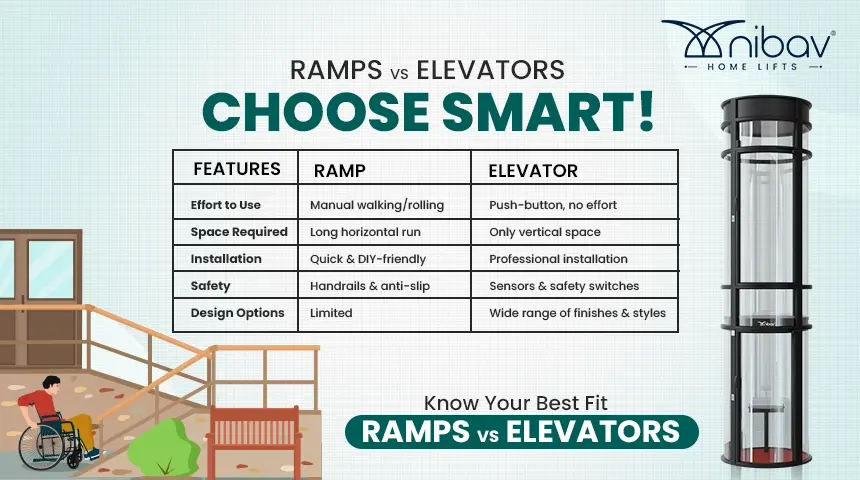
Ramp Vs Residential Elevator Comparisons
| Features | Ramp | Residential Elevator (Nibav) |
| Best used for | Small elevations with large yards | multi-floor entries or different entrances with low spaces |
| Amount of space needed | Long run of elevation | Vertical space only |
| Ease of use | Manual requires some physical effort | Push button with no effort |
| Initial cost | Lower, especially for DIY | Higher upfront, but adds design and function |
| Maintenance | Minimal maintenance—just watch for weathering effects | Regular preventive maintenance optimizes reliability |
| Aesthetic impact | Ramps can visually dominate the front yard or driveway space | Sleek, modern, and inconspicuous |
| Consideration of safety features | Requires good slope, handrails, and anti-slip finish | Gates, sensors, switches, and powered weather-resistant finishes |
| Ideal elevation height | Up ~36″ (3 feet) most practical | Can go over 4 feet for torch in entryways |
| ADA compliance check | Good slope and better landings | Custom-built to the required safety features |
Make decisions based on your layout of entry
- Flat yard with small elevation (2-3 feet or less): If you have yard space, ramps that don’t mind an inclined pathway work best.
- Very compact porch and limited yard or a higher elevation: A residential elevator works best if you have limited yard space, especially if the ramp would take up too much area, as well as ruin the curb appeal of your house.
ADA/Local Building Codes
Residential homes in the U.S. are not always legally required to meet the ADA standards, but the guidelines will help improve safety, comfort, and usability risks both operationally and from an asset and liability point of view. Not to mention it reduces injuries. ADA guidelines reference appropriate and suitable slope, landings, etc. However, many of the recommendations require a lot of space. Elevators will satisfy compliance when installed by a qualified professional. Safety features that were initially installed in elevators will work for compliance. While simultaneously considering life cycle functionality and value.
Cost & Value Over Time
- Ramps are typically less expensive to introduce and easy to maintain by simply sweeping them off or, on warm days, making plans with the weather conditions for snow, ice, and/or heavy rain.
- Elevators have a higher cost of entry but provide you with value—performance, aesthetics, and ease of access. Elevators are generally safer on ridges over 3 feet and can be less expensive and more convenient to use.
Are You Planning to Age in Place?
Advancing homeowners are prioritizing accessibility in their long-term future. A ramp will supply accessibility for needs today. However, residential elevators like Nibav offer the ability to add seamless and dignified mobility to your future needs. Overall, with residential elevators, there is functional value, and the resale value adds a higher overall value to the home if you need to downsize or move to a condo.
When Does a Ramp Make Sense?
- You have a modest elevation change and plenty of room for it.
- You have a limited budget, and you are happy to undertake a DIY build.
- You want a non-mechanical, low-maintenance path—a ramp is much more practical for friends’ temporary or infrequent visits.
When Does a Residential Elevator Make Sense?
- You have an entry with an elevation change of more than a couple of steps or with limited space.
- You are looking for good integration, curbside appeal, and ease of use for you or visitors.
- You are looking for access if you are aging in place or an elevator mobility-accessible solution in the future.
- You value elegant design, smart energy use, and safety.
Why Nibav Lifts USA?
- Stylish & Compact: Since Nibav home elevators are designed with style, they also fit compactly into narrow spaces.
- No Major Structural Work: There is no need to cut into the basement or install deep pits or machine rooms—this is ideal for renovations or existing structures.
- Clean, Efficient, and Eco-Friendly: Designed with low energy consumption while still being smart and stylish.
- Safety & Reliability: Engineered quieter and shallower rides are infinitely more comfortable with well-internationalized standards regarding home elevations.
- Value Added: Adds resale value with architectural details and gains access to spaces you may never have used before.
Frequently Asked Questions
Q: Do I need a permit to build a ramp or install an elevator?
A: Always consult your local rules and regulations. Ramps can differ widely by slope, size, and location; elevators would most likely require a permit for structural or electrical components for elevator access.
Q: What is the maintenance for ramps?
A: Ramps are easy to take care of. Typically includes what you would think—sweeping off, de-icing, and also checking for adequate anti-slip surface. Wooden ramps may also need occasional sealing, etc.
Q: Are residential elevators weatherproof?
A: Many of the Nibav models have enough finishes and designs for outdoor or semi-outdoor use, allowing for safe daily use year-round.
Q: How does slope impact a ramp’s usability?
A: The slope of a ramp contributes much to comfort and safety. A steep ramp can quickly become uncomfortable, and looking the wrong way at an icy stairway is worth the long-haul elevator choices.
The choices regarding these two ways to get customers into your house ultimately depend on whether it’s your space or a location—it’s not more than a distance journey; it’s about you as a user, your long-term plans, the space itself, and the way you perceive aesthetics. Ramps have a simplistic design and cost-effective solutions for moderate elevation, while with the Nibav home elevators it is about vertical sophistication and safety first, with conveniences to future-proof your decisions.
Let your local home’s layout, your mobility ambitions, and your pleasurable tastes inform you. In doing so, you liberate your entry space to actually be a perfect union of form and function.
Get in touch with our home elevator experts now and experience your home with a whole new level of luxury and comfort.
Talk to Our Experts
Stephen Capone
Really helpful breakdown between ramps and residential elevators! I’ve been thinking about upgrading our front entry in California, and the Nibav home elevator looks like the perfect mix of safety, function, and curb appeal. Love that it’s compact and energy-efficient too!
Yoah
Excellent guide! Accessibility has become a big topic for homeowners across the U.S., and your comparison really nails it. I appreciate how you covered ADA compliance and long-term value. The Nibav elevator sounds like a smart investment for both safety and style.
Nora
Such a clear and practical article! As someone living in California with elderly parents, the Nibav home elevator option feels like a life-changing upgrade. The part about resale value and safety really hits home—definitely something we’ll explore for our next renovation.
Victor
This is honestly one of the best guides I’ve read on ramps vs. elevators for home entryways. The explanation of slope, layout, and long-term mobility planning really helped me see why a small-footprint home elevator might be a better future investment. Great insights for anyone aging in place!
Xander
I found this blog extremely helpful, especially the real-world examples of when a ramp makes sense versus when a residential elevator is the smarter choice. ADA ramp requirements can be confusing, but you explained residential ramp slope in a way that finally clicked. Great resource for homeowners!
Colter
I appreciated how you explained residential elevator accessibility compared to traditional ramps. The ramp vs elevator cost overview was honest and balanced. It’s refreshing to see info that considers both immediate needs and long-term usability. Really helpful for real homeowners in the U.S.
Joel
Your comparison of ramp vs elevator entryway solutions was excellent. The explanations about space, slope, and long-term mobility made the decision-making process so much easier. I especially liked how you included safety details for both options.