
Table of Contents
Home elevator trends vary globally. In the USA, homeowners prioritize luxury, safety, and energy-efficient designs like those from Nibav Home Elevators USA. In Europe, the focus is on compact, eco-friendly lifts for historic homes, while Asia emphasizes space-saving, affordable, and modern elevators for urban living.
When examining the home elevator trends in the USA, Europe, and Asia, it is clear that there are key differences:
- In the USA, homeowners are focused on luxury and smart home integration, with home elevators as lifestyle improvements and accessibility options.
- In Europe, the focus is on compact, environmentally friendly, and compliant with regulation elevators that need to work in smaller, sometimes older homes, with limited space.
- In the Asia-Pacific region, there is a market surge in home elevators driven by rapid urbanization and wealth generation in cities, which has fueled a demand for luxury living and smart home integration through volume development.
To summarize: the U.S. is about luxury and smart living, Europe is about accuracy and practicality, and Asia is about growth and innovation. Now, let’s explore each of these regional tendencies in greater detail and explore what this means for the future of home elevator trends by region.
The U.S. Market: Luxury Meets Smart Homes
1. Luxury Home Elevator Trends in the U.S.
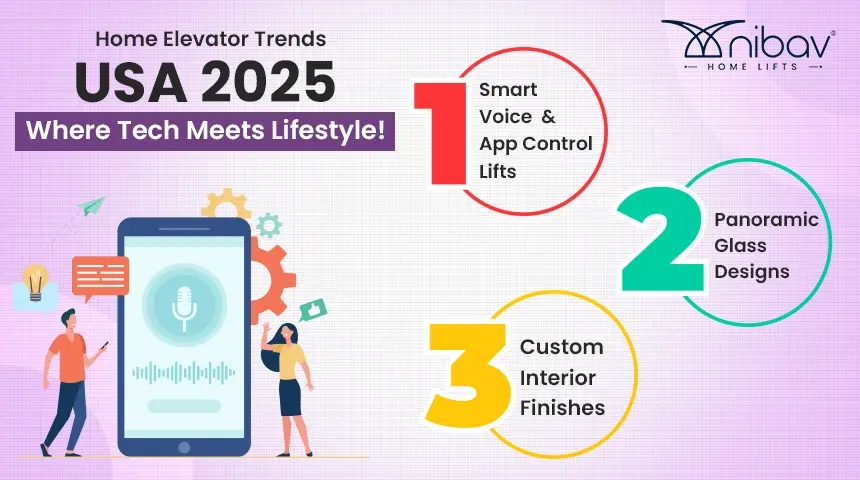
In the American residential market, elevators serve a purpose beyond usability—they’re emerging as an expression of luxury and status. Panoramic glass designs, elegant finishes, and customizable cabin interiors have become standard. Industry insights show that North America commands nearly 40% of the global luxury home lift revenue, demonstrating how integrated this trend is with lifestyle and home valuation.
2. Smart Home Elevator USA: The Technology Advantage
Americans embrace the smart home concept, and elevators can have advantages. Current consumer desires include:
- Voice control compatibility (e.g., “Alexa, call the elevator”).
- Touchless buttons for hygiene and convenience
- Remote control monitoring apps that provide homeowners with real-time monitoring of their elevator status and service notifications
The smart home elevator USA market mirrors a trend towards a greater appreciation for integrated, connected living spaces.
3. Accessibility With Style
As the population ages and multigenerational households become a necessity, accessibility is an inherent target. But Americans want pretty lifts, too! ADA-compliant systems focus on design aesthetics that are both practical and elegant, an American concept.
Europe: Precision, Practicality, and Heritage Preservation
1. New Elevator Trends Emerging in Europe
Compared to Asia, Europe is growing steadily, rather than exponentially. The rate of Europe’s growth is around 7% CAGR. Unlike the United States, Europe is not seeking luxury. Functionality, safety, and regulation are emphasized in the region.
2. Compact and Space-Conserving Perspective
Many older homes in Europe do not allow for large elevators. Therefore, there is demand for space-saving shaftless elevators, such as vacuum lifts or smaller hydraulic systems. The comparison of the space-saving vacuum elevator vs the hydraulic elevator for small homes is pertinent in this case.
3. Environmentally-Friendly and Highly Regulated
Europe is a leader in sustainability. Energy-efficient, low-carbon material choices and compliance with EU safety directives have influenced the market. Europe is not driven by “luxury-first” demand like the United States; it values green, compact, and easy-to-retrofit systems.
4. Heritage Meets Contemporary Design
In European cities such as Paris, Rome, or London, elevators can be required to be installed in buildings that are hundreds of years old. Hence, the request for discreet, architecture-adaptable elevators is a uniquely European perspective.
Asia-Pacific: Growth, Luxury, and Smart Integration
1. Residential Elevator Growth Asia
There is no region growing faster than Asia-Pacific, which now represents over 50% of global residential elevator revenue. There are three countries that are urbanizing rapidly—China, India, and Japan- and elevators are no longer a luxury; they are becoming an expected amenity in new builds.
2. Solid Lift Trends in Asia-Pacific
- Smart Elevators Everywhere: IoT-powered elevators are showing up with features like facial recognition, voice control, and even pet-detecting sensors
- Luxury Boom: With rising wealth in China, India, and Southeast Asia, homeowners are using elevators as a way to show off their wealth and lifestyle.
- Compact Innovations: Smaller suites mean smaller elevators. Compact or saddle designs like vacuum elevators are now gaining popularity.
3. Multi-Generational Living
In Asia, unlike the West, it is common for families to share homes. Elevators are used in this scenario less for luxury and more for functionality, for grandparents to use or kids to share.
Regional Trends at a Glance
| Region | Key Trends & Drivers |
| USA | Luxury, smart-home integration, accessibility + aesthetics |
| Europe | Compact, eco-friendly, regulated, retrofit-friendly |
| Asia-Pacific | Fastest growth, luxury boom, urban & smart innovations |
Each region’s home elevator market is shaped not just by technology, but also by lifestyle, culture, and infrastructure realities. In the U.S., an elevator is often chosen as a lifestyle upgrade. In Europe, the challenge is making elevators fit seamlessly into older, tighter spaces. And in Asia-Pacific, it’s about keeping pace with booming urban growth while appealing to new wealth.
Unique Perspectives Shaping Regional Trends
1. Shaftless Elevators are a Game Changer
One of the most interesting global trends is the growth of shaftless elevators, particularly pneumatic (vacuum) elevators. Shaftless elevators do not require deep pits or even a machine room, which makes them much easier to install in existing homes.
- In Europe, where townhouses and heritage apartments are predominant, this is a perfect technology for owners to retrofit for modern convenience without compromising the historic interior of their homes—for example, adding access to a loft or basement.
- In Asia, where dense and expensive cities limit space, shaftless elevators enable compact homes to operate vertically without compromising the footprint of the living space.
These advances will continue to intuitively shift the constraints of residential architecture worldwide.
2. Regulations as Market Drivers
Regulations have a more significant impact than is commonly recognized:
- U.S.: Governed by standards such as ASME A17.1 Section 5.3, the U.S. referred codes allow homeowners flexibility while using a safety-oriented standard. This balance creates more creative design options and allows for luxury-driven installations.
- Europe: The safety and environmental regulations are committed and extensive. Elevators must follow a series of EU standards greatly focused on energy efficiency, environmental operation, and rigid testing for safety. More bureaucracy results in slower adoption but constant quality.
- Asia-Pacific: The regulations vary by country. Some countries, like Japan, have minimal regulations and very high worldwide standards, while other emerging economies are even more flexible, resulting in quicker adoptions. This lower level of bureaucracy also means that countries in Asia can quite a variety of innovations, from AI elevators to biometric access systems.
3. Cultural Lenses on Elevators
Why people buy elevators often comes down to culture:
- In the United States, elevators are becoming more and more of a status symbol. They denote status to a property but also provide the convenience of transport. Luxury homeowners demand a lift that they can show off as more than just a means of transport.
- In Europe, elevators are much more straightforward. With older demographics and just old houses, the focus is much more on safety, small footprint, and functionality—an elevator is more of a tool than a status symbol.
- In Asia, elevators are becoming a necessity very quickly. With denser big-city living, there are homes and flats with multiple levels that require vertical movement. An elevator, therefore, is about taking the lift to keep up with the fast-paced urban dwellings, much less a showcase for status.
Future Outlook: Where Are Home Elevator Trends Headed?
Going forward, each region will diverge along its own continuum:
- USA: Future developments will incorporate AI into elevators that can predict maintenance, recognize voice commands, and connect to wellness monitoring technologies. The smart home will become more integrated, while luxury customizations will continue to be the primary growth segment.
- Europe: In Europe, there will be a stronger emphasis on elevators designed for retrofitting purposes meant to fit into narrow stairwells and older buildings, while sustainability will be a priority. EU regulations on sustainability will only grow stricter and provide stricter requirements for manufacturers. Expect more low-energy systems, recyclable materials, and strict indoor air quality standards.
- Asia-Pacific: The Asia-Pacific region is set for massive growth, and soon it will be cheaper to put elevators in new builds consistently rather than not. Demand for elevators will follow population growth, with urban populations rising, and elevators will become as standard as appliances in new builds. Expect smart elevators to become the baseline standard, inclusive of features and attributes that create benefits in convenience, security, and energy performance. The luxury segment will continue to grow, particularly for high-net-worth households in China and India.
Conclusion
The difference between home elevator trends USA vs Europe vs Asia reflects deeper cultural, economic, and lifestyle differences.
- The U.S. wants luxury and smart convenience.
- Europe values precision, eco-friendliness, and compact design.
- Asia-Pacific is growing fastest, embracing smart, luxurious, and functional lifts for dense urban living.
Together, these markets are shaping the future of home elevators, where technology, design, and lifestyle come together in unique, region-specific ways.
Get in touch with our home elevator experts now and experience your home with a whole new level of luxury and comfort.
Talk to Our Experts
David
Really insightful read! I never realized how different home elevator trends are between the USA, Europe, and Asia. The U.S. focus on luxury and smart integration stood out to me, especially those voice-controlled elevators. Great breakdown of global perspectives on residential lift innovation!
Joseph
This blog gave such a clear picture of how luxury home elevator trends vary worldwide. I love how the U.S. focuses on smart living, while Europe’s precision and Asia’s innovation balance it all. It’s amazing to see how lifestyle and culture shape the future of home elevators.
Matthew
I found this article incredibly helpful! The comparison of home elevator trends USA vs Europe vs Asia really shows how each region’s priorities differ. The note about shaftless elevators changing design possibilities was my favorite. Great insight into global luxury home lift trends!
Jackson
I enjoyed reading this! Your analysis of home elevator trends Asia was spot on especially how rising wealth and urbanization drive elevator adoption. I liked learning about how Asia is becoming the fastest-growing market in global luxury home lift innovation.
Maverick
This blog perfectly explains why shaftless elevator trends are taking over worldwide. The points about space-saving tech in Asia and heritage retrofits in Europe were fantastic. Really appreciate how detailed yet understandable the comparisons were. Excellent work!
Miles
Fantastic post! I’ve been researching smart home elevator systems in the USA, and this helped me understand how innovation differs across markets. The mention of AI integration for future elevators makes me excited about the future of home elevators overall.