
Table of Contents
- Why Home Elevator Sizes Matter
- Hydraulic Elevators: Powerful, But Not for Tight Spaces
- Standard dimensions for hydraulic elevators:
- Pneumatic Elevators: Compact, Elegant, and Perfect for Modern Homes
- Nibav USA Pneumatic Models
- Why Nibav pneumatic elevators are ideal for U.S. homes:
- Wheelchair Lifts: Accessible but Limited
- Typical dimensions and requirements:
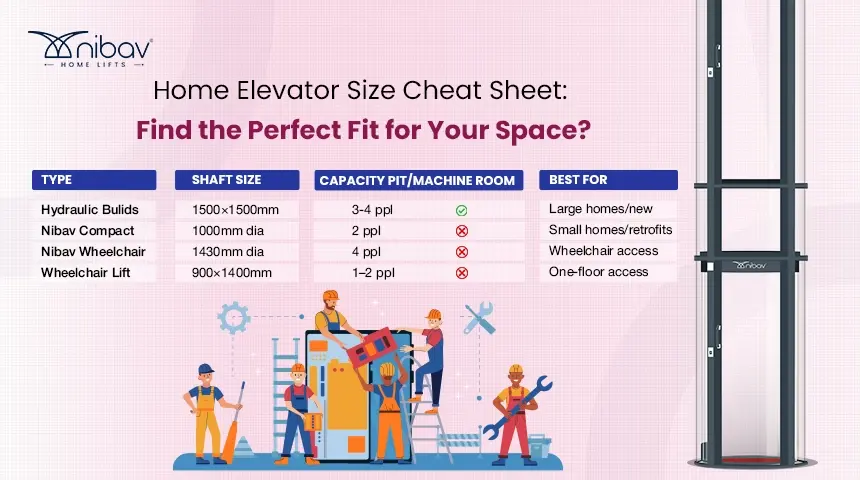
- Elevator Type Comparison: Sizes at a Glance
- Choosing the Right Elevator for Your Home and Lifestyle
- Conclusion: Fit More, Stress Less—The Nibav Space Advantage
Size does matter when it comes to home elevators. The available space in your home impacts what kind of elevator you can install. Some elevators require deep pits, multiple floors of space for elevator shafts, and separate rooms for the machines. Others, like Nibav USA’s pneumatic elevators, provide full functionality in terms of performance and design while occupying the least amount of space possible and maintaining a sleek, space-saving design that works well in any interior.
To put it simply: If you’re looking for an elevator that can fit in tight spaces and doesn’t compromise functionality or design, pneumatic elevators are the best choice. In this blog, we will compare the sizes of home elevators with three main types: hydraulic, pneumatic, and wheelchair lifts. We will cover cabin sizes, space requirements, and how each type of elevator differs from the others to help you make a more informed, space-conscious decision for your home.
Why Home Elevator Sizes Matter
Selecting an elevator isn’t just about vertical movement. It’s about:
- Urging compatibility into your footprint without extensive renovations or structural changes
- Lending aesthetic modernity without heavy, bulky, or obtrusive apparatus
- Providing access for family members of every age and ability
- Enhancing resale value with smart and efficient use of space
- Providing long-term convenience with little to no ongoing maintenance
Effective elevator size not only makes life easy, it also contributes to ‘livability,’ with a more functional, inclusive experience that is also future-proof for generations to come.
Hydraulic Elevators: Powerful, But Not for Tight Spaces
Hydraulic elevators are a classic option for homes. They are powered by a piston that moves the elevator cab via fluid pressure. Hydraulic elevators are strong, reliable, and provide a smooth ride.
Standard dimensions for hydraulic elevators:
- Cabin dimensions: 900 mm-1100 mm wide, and sometimes larger depending on customization.
- Shaft dimensions: Minimum of 1500mm x 1500mm
- Pit depth: 400mm to 1200mm, depending on model and travel height
- Machine room: Required (usually a separate room or closet for housing the hydraulic pump and control systems).
Pros:
- High weight capacity—great for heavy-duty applications.
- Smooth and quiet ride with accurate stopping capabilities.
Cons:
- More construction work and required structural modifications.
- Not great for existing homes, and not ideal for compact spaces with limited space.
- Higher long-term maintenance costs with the possibility of fluid leaking over time.
Hydraulic elevators are best suited for oversized homes that have a larger square footage or custom builds that allow for space to be designated from the beginning.
Pneumatic Elevators: Compact, Elegant, and Perfect for Modern Homes
Pneumatic elevators operate using air pressure and vacuum technology. This allows for a sleek, self-contained system with minimal structural requirements. They are a go-to choice for space-conscious homeowners and modern architectural styles.
Nibav USA Pneumatic Models
Compact Model:
- Clear shaft diameter: 1000mm
- Cabin usable diameter: 830mm
- Capacity: Up to 2 passengers comfortably
- Travel height: Up to 4 Floors
Wheelchair-Friendly Model:
- Clear shaft diameter: 1430mm
- Cabin usable diameter: 1240mm
- Capacity: Up to 4 passengers or a standard wheelchair user plus companion
- Travel height: Up to 4 Floors
No pit, no shaft walls, and no machine room required. These elevators are plug-and-play compared to traditional systems, which means installation is faster, easier, and less disruptive.
Why Nibav pneumatic elevators are ideal for U.S. homes:
- Easy to retrofit into existing structures without compromising layout
- Transparent tubes keep spaces open, bright, and airy
- Minimal installation time and little disruption to daily life
- Operates using a standard household power supply
- Stylish and customizable to blend into any interior
Pneumatic elevators are the future of compact vertical mobility, combining convenience with cutting-edge engineering and timeless design appeal. They’re efficient, low-maintenance, and ideal for multi-generational living or aging-in-place.
Wheelchair Lifts: Accessible but Limited
Wheelchair lifts (also known as platform lifts) are often used for short vertical distances—between a garage and the main level, split-level landings, or porches. They offer accessibility solutions where full elevators may not be feasible.
Typical dimensions and requirements:
- Platform size: Approximately 900mm x 1400mm
- Travel height: Up to 4–5 feet (limited compared to multi-story elevators)
- Shaft: Not required in most cases
- Pit: Usually not needed; installed at-grade or with minimal ramp
Pros:
- Lower cost than full residential elevators
- Great for targeted accessibility retrofits
- Faster to install and requires less structural change
Cons:
- Less aesthetically pleasing than enclosed elevator systems
- Limited travel height and fewer design options
- Open design may not be suitable for all home layouts or climates
Wheelchair lifts are excellent for solving specific accessibility challenges, but aren’t a replacement for full-service elevators. They serve as a practical solution for short distances and one-level challenges but lack the design flexibility and comfort of elevator systems.
Elevator Type Comparison: Sizes at a Glance
| Elevator Type | Shaft Size | Cabin Size | Capacity | Pit/Machine Room? | Ideal For |
| Nibav Compact | 1000 mm diameter | 830 mm diameter | 2 ppl | ❌ | Small homes, retrofits, condos |
| Nibav Wheelchair | 1430 mm diameter | 1240 mm diameter | 4 ppl | ❌ | Wheelchair access, family homes |
| Hydraulic | 1500 mm x 1500 mm+ | 1100 mm width | 3–4 ppl | ✅ | New builds, large homes |
| Wheelchair Lift | 900 mm x 1400mm | Open platform | 1–2 ppl | ❌ | One-floor access, garages |
This quick breakdown shows that pneumatic elevators lead the pack when it comes to balancing form, function, and footprint. They offer both vertical mobility and elegant design in a space-efficient package.
Choosing the Right Elevator for Your Home and Lifestyle
Ask yourself:
- How much space can I realistically spare without sacrificing functionality?
- Am I planning a new build, remodeling, or retrofitting an existing home?
- Do I need an elevator for accessibility, daily convenience, or both?
- How important are energy efficiency, speed of installation, and aesthetic integration?
For most homeowners, especially in compact urban or suburban U.S. homes, a pneumatic elevator checks all the right boxes:
- Minimal installation space and no structural headaches
- Elegant design options that complement interiors
- Future-ready functionality that adapts to changing mobility needs
And with models like those offered by Nibav USA, you get all the benefits of modern engineering without sacrificing style or comfort. Nibav elevators are not just compact—they’re also sustainable, energy-efficient, and built to meet the demands of contemporary living.
Conclusion: Fit More, Stress Less—The Nibav Space Advantage
Not all elevators are created equal. Hydraulic elevators might be strong and reliable, but they demand serious space and construction time. Wheelchair lifts are cost-effective but come with travel and design limitations. Pneumatic elevators, especially from Nibav USA, strike the perfect balance—compact, stylish, and easy to install in just about any home.
If you’re considering a home elevator, think beyond just “going up.” Consider how much space you’re willing to dedicate, how your needs may evolve, and how to keep your home both beautiful and accessible as your family grows or ages.
Ready to learn more? Get in touch with Nibav USA today and discover how their compact elevators can transform your vertical space—with as little as 1000 mm of clear diameter. Whether you’re upgrading for convenience, accessibility, or style, Nibav makes it possible with a compact, plug-and-play solution that fits.
Ready to learn more? Get in touch with Nibav USA today and discover how their compact elevators can transform your vertical space—with as little as 1000 mm of clear diameter. Whether you’re upgrading for convenience, accessibility, or style, Nibav makes it possible with a compact, plug-and-play solution that fits.
Get in touch with our home elevator experts now and experience your home with a whole new level of luxury and comfort.
Talk to Our Experts
Donna Jones
As someone planning a home renovation, this blog hit the mark. It’s great to see how Nibav USA’s elevators combine smart design with energy efficiency. I appreciate how you explained space requirements in detail, it’s not just about luxury; it’s about practicality and future-proof living.
Nick Fortis
Fantastic read! I’ve been worried about fitting an elevator into our existing home layout, and this post explained how pneumatic elevators like Nibav’s can easily retrofit without major construction. Love the focus on space-saving and modern design. Thanks for making it easy to understand!
Marty Brown
Really helpful guide! I was torn between a hydraulic system and a pneumatic one, but after reading this, the choice is obvious. The Nibav USA models sound compact, stylish, and low-maintenance, exactly what we need for our two-story California home. Great job explaining the pros and cons clearly!
Joann Sorrenti
This post gave me the clarity I needed. I’m building a new home and wasn’t sure which elevator type would fit our plans. The Nibav pneumatic option makes so much sense: no pit, no machine room, and a sleek design. Love how this blog focuses on real-world space considerations for U.S. homes.
Darrell Nunnelley
Very insightful article. I didn’t realize wheelchair lifts were so limited compared to pneumatic elevators. The detailed dimension comparisons were especially useful. Nibav USA seems to have the perfect solution for families who need accessibility and style without sacrificing floor space.
Sundeep Chahal
Loved this breakdown of home elevator types. I’ve been looking for something modern and minimal, and the Nibav USA pneumatic elevator sounds perfect. The way you covered shaft sizes and installation needs made it simple to compare options. Super helpful for anyone planning a retrofit!