
Table of Contents
- Introduction—An Innovative Approach to Mobility in the Home
- What is a pneumatic elevator?
- What is the cost of pneumatic elevators?
- Highlights of Nibav Pneumatic Elevators
- Cost Drivers for Pneumatic Elevators
- Cost vs. Value—Why Nibav is an attractive option for homeowners
- Long-Term Maintenance and Operating Costs
- Who Should Consider a Pneumatic Elevator?
- Conclusion—Investing in the Future of Living
- Frequently Asked Questions (FAQs)
The cost of a pneumatic elevator typically ranges from $50,600 to $103,600, depending on size, customization, and installation needs. It’s a space-saving, low-maintenance option ideal for homeowners seeking modern, safe, and energy-efficient vertical mobility.
Introduction—An Innovative Approach to Mobility in the Home
Homeowners are always on the lookout for ideas and products that represent luxury, convenience, and accessibility. As a part of the home mobility design, pneumatic elevators, sometimes called vacuum elevators, are one of the fastest-growing areas in design for residential living. Pneumatic elevators operate by utilizing the vertically moving air pressure that propels the elevator cabin up and down between floors, rather than the traditional elevator’s weight or hydraulic system. Because a pneumatic elevator does not require a typical machine room or deep pit with heavy construction, it can be installed virtually anywhere in a home.
For many homeowners in the U.S., the pneumatic elevator serves as a symbol of both taste and practicality. One of the first questions a homeowner may ask themselves is, “How much does a pneumatic elevator cost, and what considerations do we need to examine closely before purchasing one?”
This article encapsulates everything homeowners need to know regarding pneumatic elevator cost, components that can affect pricing, and lastly, why Nibav USA is revolutionizing the affordability, design, and safety of elevators in homes.
What is a pneumatic elevator?
The pneumatic elevator is a type of lift that is cylindrical in design, free-standing, and self-supporting and uses air pressure for its design and the movement of people in a home. The elevator cabin moves smoothly in either direction by creating a differential in atmospheric pressure in the pneumatic elevator shaft suits.
Conventional lifts utilize weight to pull cab movements, and pneumatic elevators utilize atmospheric pressure to positively affect the pull without significant weight. Pneumatic elevators do not and are designed to:
- Have no pits or machine rooms required according to the defined codes.
- It has a self-supported structure and can be installed in a pre-existing home.
- Have 360-degree views available through their polycarbonate glass composition.
- Use single-phase power, making them eco-friendly and energy efficient.
For homeowners in the U.S. looking for solutions for remodels at the existing home or lower costs and physical use of space in a new multi-level home, pneumatic home elevator cost represents a practical, design-friendly solution for increasing vertical access for mobility in homes.
What is the cost of pneumatic elevators?
The pneumatic vacuum elevator cost can depend on several factors, but some options for homeowners living in the U.S. include:
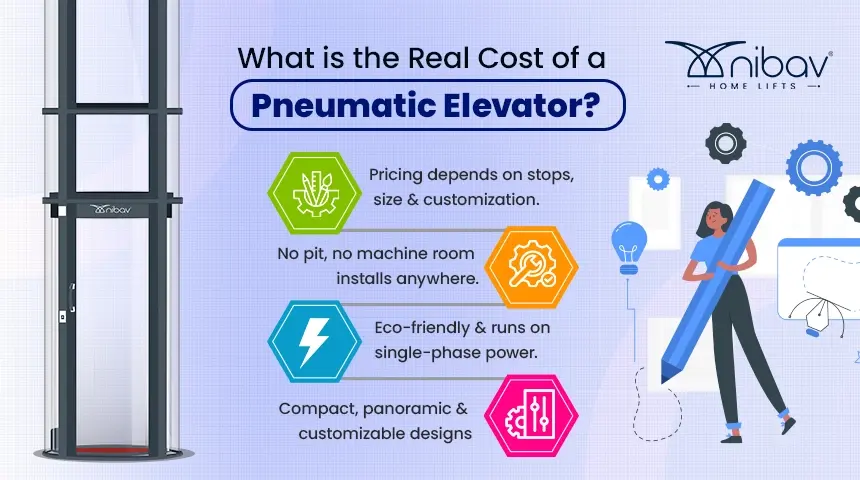
1. Number of Stops – A two-stop (G+1) elevator is typically less expensive than a four-stop (G+3) elevator.
2. Capacity and Width – Nibav’s Series IV and Series IV Max come with options of 210 kg (462 lbs) and 240 kg (529 lbs) capacity, so this can influence pricing.
3. Customization Options – Designer finishes, hydro-dipping, leather seating, smoked glass, etc., will increase price.
4. Installation Conditions – Nibav lifts are self-supporting lifts that are modular and therefore have little to no civil work involved. Yet, unique placement of the pneumatic lift, like balconies or tight fit placements, may still impact the total pricing.
5. Warranty/Maintenance – Pneumatic elevators are typically way less than an AMC/A&AW (Annual Maintenance Contract/Annual Warranty) prices if you consider the advanced technology limits maintenance needs.
So, while it is impossible to provide the exact cost of PVE elevators due to configuration and geographical regions, pneumatic elevators generally cater to a demographic that can be described as a luxury product that is now accessible for modern-day homes.
Homeowners gain more than enhanced accessibility; in the long term, there is also increased property value.
Highlights of Nibav Pneumatic Elevators
Nibav USA provides pneumatic elevators that are the next level, with features that improve the living experience:
1. A Self-Supported Structure
The elevators have their own shaft, in polycarbonate glass (that’s 250 times stronger than regular glass), so it does not need an alternative support structure.
2. Lightweight but Sturdy
The elevators are made of aluminum and galvanized steel, and have a total weight close to 680 kg for two stops, allowing the elevators to go on any existing floor, outdoor balcony, etc.
3. Aesthetic Versatility & Luxury Appeal
There are various options available when customizing the elevator, from hydro-dipped finishes and leather-wrapped handles to starlight ceiling effects. You will be able to match the elevator to your interior décor.
4. Quiet & Smooth ride
The elevators have suspension systems, synchronous motors, and Lidar 2.0 technology to provide seamless landings while noise levels remain at only 57 dB, quieter than most household appliances.
5. Layers of Safety
Nibav includes several layers of safety, including:
- Automatic descent during a power failure.
- Rapid Rescue Latch (RRL) in case of an emergency evacuation.
- Electronic and electric locks operate the elevator.
- ISO 9001:2015 & TÜV NORD Certification for safety and quality assurance.
6. Smart Technology
In several ways, including digital twin, a variety of customizable displays for the cabin, automatic SOS, and app-based control, the elevators are future-ready.
Cost Drivers for Pneumatic Elevators
When planning for costs involved in purchasing, a pneumatic elevator may have different drivers of cost, which can include:
1. Model/Series of unit
- Series IV (Standard): Most compact and can be finished to fit most contemporary homes.
- Series IV Max: Capable of carrying a higher weight capacity with a larger cabin.
2. Stops and height of travel
- A standard elevator can have up to G + 3 (4 stops) and 531 inches of travel height.
- More stops equal a larger investment.
3. Customization
- Customization options (i.e., Midnight Edition, hydro-dipped finishes, laser-cut lighting, and leather seating) add to the total price of the elevator but also differentiate your home.
4. Installation and relocation flexibility
- Nibav lifts are modular and can be taken apart and put back together—this flexibility provides long-term value.
5. After-sales
- Warranty and AMC services provide long-term value if repairs are required.
Cost vs. Value—Why Nibav is an attractive option for homeowners
Many homeowners think of pneumatic elevators as more expensive (premium) compared to hydraulic or traction elevators. There is also value in pneumatic options that have hidden savings, which could make it a wiser option. Example savings could include:
- No costs associated with a pit or shaft construction.
- Reduced maintenance from once (1X) every 4 months instead of monthly.
- Energy saving in costs from providing minimal power (pneumatic consumption).
- Faster installation, which greatly reduces disruption in your household.
- Future technology will certainly allow for the value of your property.
In conclusion, the price isn’t just for the elevator itself but also for the convenience, safety, and luxury that accompany everyday life.
Long-Term Maintenance and Operating Costs
Operating costs for a pneumatic elevator are far less than those of a conventional elevator:
- They operate on single-phase power, so they are suitable for most homes in the U.S.
- No oil/lubrication is required – eliminates costly maintenance.
- Maintenance occurs every four months, which reduces service costs.
- Motors have lifetime warranties, yet another assurance you can have.
This means pneumatic elevators aren’t just a luxury buy; they are a low-cost, long-term investment.
Who Should Consider a Pneumatic Elevator?
Pneumatic elevators are great for:
- Older homeowners who are looking for more accessibility.
- Families with children who are looking primarily for convenience and safety.
- Luxury home buyers who want a wow factor.
- Renovators were unable to include a pit-based elevator.
- Compact living spaces, and when the use of an elevator will be feasible.
Conclusion—Investing in the Future of Living
So, what’s the cost of a pneumatic elevator? In the end, the question cannot only be a dollar amount but really a value addition to your lifestyle. Nibav USA’s pneumatic elevators are raising the bar for accessibility—across affordability, luxury, and safety.
With zero civil works, a design that is well thought out, only using the very best materials, ISO 9001:2015 & TÜV NORD certified manufacturing, and best-of-breed technology – a pneumatic elevator is not only an elevator, it is the smartest choice for both comfort and future value.
For U.S. property owners embarking on their next home improvement project, a pneumatic elevator is more than simply moving between floors; it is also embarking on the shape of future home ownership.
Frequently Asked Questions (FAQs)
1. How long does the installation take?
The modular Nibav pneumatic elevator can be installed in under 4-5 days due to its knockdown design.
2. What do they do in a power outage?
Nibav elevators descend to the ground floor with no battery in the case of a power cutoff.
3. How much room do they take up?
A standard model takes a minimum of 40 inches of room for the elevator, meaning it can be a compact living.
4. Are pneumatic elevators safe for children and seniors?
Yes. A children’s safety switch, alarms for emergencies, and controlled/smooth descent make this a safe product for all families.
5. Will the elevators fit in a new place?
Yes. All Nibav elevators can be built down to the modular level and rebuilt at a new house; it can therefore be a financially and tangibly prudent investment.
Get in touch with our home elevator experts now and experience your home with a whole new level of luxury and comfort.
Talk to Our Experts
Angela Machado
This article really dives deep into what makes pneumatic elevators stand out from traditional hydraulic lifts. I had no idea they could be installed without major construction or that they run on single-phase power. The pricing breakdown and customization options are super helpful for homeowners like me planning a remodel. The part about Nibav’s TÜV NORD certification gave me extra confidence in their safety standards.
Marie Estepa
Excellent breakdown of pneumatic elevator costs and features. The fact that Nibav’s models don’t need a pit or machine room is such a game-changer for retrofitting existing homes. As someone exploring aging-in-place options for my parents, this article gave me clarity on what to expect cost-wise and how installation works.
Jacob Lewis
Love how clearly this guide explains the benefits and pricing of pneumatic elevators. It’s refreshing to see such transparency about cost factors like customization and number of stops. The low maintenance and quiet ride really make Nibav USA’s elevators feel like the future of home accessibility.
charles dennany
Wow, this is such a thorough and well-written guide! I never knew pneumatic elevators could add so much value to a property. The details about smart technology and self-supporting structure make Nibav’s elevators sound both stylish and practical. Definitely considering this for our next home renovation project.