
Table of Contents
Vacuum elevators differ from hydraulic elevators in design, operation, and efficiency. Nibav Home Elevators USA uses air pressure instead of oil or cables, making them eco-friendly, space-saving, and easy to install. Unlike hydraulic lifts, they require no pit or machine room, offer smoother travel, and need minimal maintenance.
Introduction: Vacuum Elevator vs Hydraulic Elevator
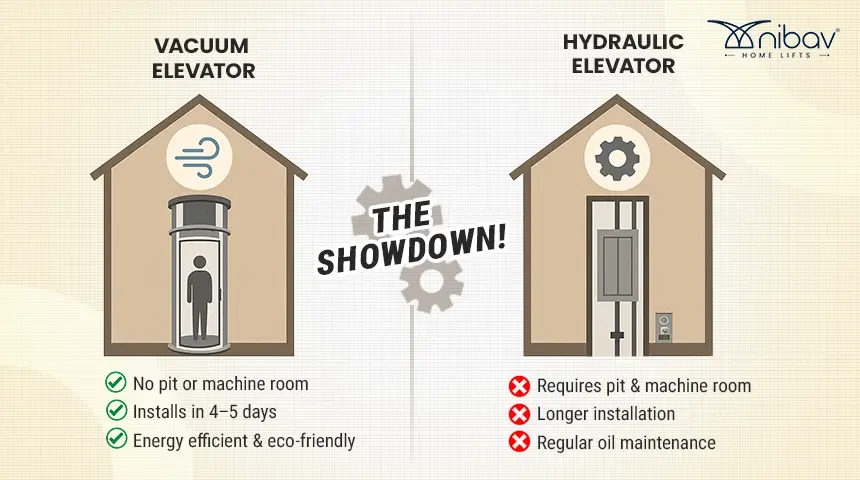
The main difference when you are comparing a Vacuum Elevator vs a Hydraulic Elevator is how they work and the effect on your home. A vacuum elevator moves the cabin with air pressure. This means that it does not require a pit, a machine room, and it takes up very little space. It installs in a few days, is energy efficient, and has built-in safety systems. A hydraulic elevator uses a piston with hydraulic fluid. This requires a machine room, a pit, and more space, takes longer to install, and needs more service and maintenance.
So, if you’re comparing a vacuum elevator vs a hydraulic elevator, the short answer is this:
- Vacuum elevators are space-conscious, modern, safe, and small in installation time.
- Hydraulic elevators are bigger, traditional, and service-heavy.
In this blog, we are going to discuss the space-saving vacuum elevator vs hydraulic elevator for small homes, installation time comparison: vacuum vs hydraulic elevator, safety features vacuum elevator vs hydraulic elevator, and help you make a decision if one of these elevators is right for your home.
1. Quick Comparison: Vacuum Elevator vs Hydraulic Elevator
| Feature | Vacuum Elevator | Hydraulic Elevator |
| Technology | Air pressure + pneumatic system | Piston + hydraulic fluid system |
| Space Needs | No shaft, pit, or machine room | Needs shaft, pit, and machine room |
| Installation | 4–5 Days | Weeks (structural modifications needed) |
| Safety | Multiple fail-safes, automatic braking | Safe, but oil leaks & pit risks |
| Maintenance | Minimal, eco-friendly | Regular oil changes, higher costs |
| Best For | Small homes, retrofits, modern designs | Heavy loads, high-rise use |
2. How the Technology Works
A Vacuum Elevator Uses Air, Not Cables
A vacuum elevator is hyper-specialized to work on the laws of air pressures and pneumatic actions on an open lift system with a round, clear shaft. The elevator cabin sits inside the shaft, and at the very top, turbines suck the air out of the cabin. The motion of the elevator is an upward pull of air into a vacuum, and when you want to come down, air valves bleed pressure off slowly so that the cabin gently returns to the ground using gravity.
Instead of the traditional ropes and pulleys or counterweights, a vacuum elevator is a fully self-contained air lift cage that is highly functional. Many owners describe the experience as surprisingly quiet, steady, and even comfortable, while also appearing effortlessly futuristic and technically simple.
A Hydraulic Elevator Uses Oil to Push Heavy Loads
A hydraulic elevator is a hydraulic-cable elevator that consists of a hydraulic cylinder with a piston and hydraulic fluid. To elevate the cabin, a hydraulic pump supplies hydraulic fluid into the cylinder; the fluid pressurizes and pushes the piston up, elevating the cabin.
To bring the cabin down again, the cylinder allows the hydraulic fluid back into the reservoir slowly. This works brilliantly at carrying heavy weights, but with more moving parts comes a more complicated system. Hydraulic elevators do have some commercial appeal as a system-in-your-face-reminder-of-how-efficient it can be in repetitively transporting very heavy loads.
They are more complicated to install within a residential area than a vacuum elevator. Both require pits and support systems, and dedicated machine rooms for the control equipment. In the end, hydraulic elevators feel excessive and invasive in dense residential environments.
3. Space Requirements
The difference between a space-saving vacuum elevator vs a hydraulic elevator for smaller homes is evident.
- Vacuum elevators- Self-contained systems that follow a cylindrical design and only need floor space. There is no pit, a machine room, or an overhead shaft to worry about. They are an option for compact homes, duplexes, or retrofits where a homeowner doesn’t want to give up living space. Flexible installations mean a vacuum elevator can often be positioned in corners, by staircases, or even in the middle of the room as a design element.
- Hydraulic elevators: Require a machine room for the pump, a pit beneath the floor, and a substantial shaft, thus compromising usable space in a residence and likely requiring structural alterations. For a compact home, this often requires giving up a room or a large section of a room to allow the elevator.
For modern families mindful of every square foot, a vacuum elevator is the clear choice.
4. Installation Time Comparison: Vacuum vs Hydraulic Elevator
One of the most practical considerations that can be made when comparing these elevators concerns the installation times.
- Vacuum elevators: As a vacuum elevator does not require structural modifications for installation, the process is relatively straightforward. Most vacuum elevators can be installed in about 4-5 days, depending upon customization. They require minimal interference in daily life, and there are no extended weeks of noise and dust from construction.
- Hydraulic elevators: Installing a hydraulic system can take several weeks to install, as builders need to excavate for a pit, build the machine room, and prepare the shaft. It is a very invasive process, especially in existing homes, that can substantially increase project costs.
If you are looking for a fast and painless solution to installing an elevator in your home, vacuum elevators are clearly the more convenient option.
5. Safety Features
When you are deciding on an elevator, safety is paramount, and there is no confusion in comparing the differences when it comes to safety.
- Vacuum elevators: These elevators generally have several built-in safety features. If there is a power outage or a loss of pressure, automatic brakes would engage, and the cabin would similarly descend at a controlled speed to the ground floor. As there are no cables or pulleys, there is nothing to break, and the system design means that movement is purely controlled and smooth. A vacuum elevator is also safe for the environment and does not pose a risk of oil pollution or chemical hazards.
- Hydraulic elevators: A hydraulic system’s overall safety is also generally not an issue; however, they may also require mechanical checks on a periodic basis to test overall reliability. Also, a hydraulic elevator’s hydraulic systems can develop oil leaks, or the pit can flood, or the components can wear over time. Even hydraulic elevators have emergency systems; they can also rely on servicing.
In summary, when considering built-in safety features and reliability with minimum maintenance, vacuum elevators allow a homeowner greater peace of mind.
6. Cost and Maintenance
Both elevator types can have multiple purchase price points based on size and modification, but the key difference is long-term ownership costs.
- Vacuum elevators: Vacuum lifts are simple low maintenance systems. There are no oils to change, no pits to maintain, and fewer moving parts to service. They are also energy efficient. Vacuum elevators only consume power when going up, and descending is all powered by gravity, usually reducing ongoing costs.
- Hydraulic elevators: Often, lower up-front costs lead to a higher long-term cost. The ongoing costs can add up too quickly with oil changes, pit maintenance, and servicing the machine room. Hydraulic elevators also consume more energy to operate, especially in use cases of frequent use.
Over 10-15 years, almost every homeowner will see the advantage of vacuum elevators in overall, and less expensive long-term maintenance.
7. Design and Aesthetic Appeal
Another significant difference between vacuum elevators and hydraulic elevators relates to their aesthetic appeal and how they function in a home.
- Vacuum elevators: vacuum elevators have a modern design that features panoramic glass that feels sleek, open, and elegant. Vacuum elevators can essentially be installed anywhere in a house – they serve both as a mobility solution and a fashionable statement. Their futuristic design regularly continues to add value to a home.
- Hydraulic elevators: While all elevators are designed to work, not every elevator is designed to be seen. Hydraulic elevators are typically designed to be hidden within a wall or shaft and have an overall functional purpose, versus a decoration. Hydraulic elevators are obstructed by the bulky infrastructure it takes to accommodate the elevator, making it that much less likely to enhance a home’s aesthetic.
For homeowners who want to have an elevator that operates and is aesthetically pleasing, vacuum elevators are clearly better suited for the task.
8. Best Use Cases
Choosing between these two technologies ultimately comes down to what kind of home you have and what you need from your elevator.
- Vacuum elevators: Best for small to medium-sized homes, retrofits, and modern residences. They are ideal for families seeking space efficiency, eco-friendly operation, and a stylish addition to their home.
- Hydraulic elevators: Best suited for heavy-duty applications, larger homes, commercial spaces, or high-rise buildings. They can carry heavier loads and serve taller structures, but are less convenient in compact residential settings.
Conclusion
When considering a vacuum elevator vs. a hydraulic elevator, the decision is purely what fits your needs. If you are a homeowner looking for a space-saving, safe, environmentally-friendly, and aesthetically pleasing elevator, do not hesitate. Vacuum elevators win, hands down. Vacuum elevators are quicker to install, as they require no extensive underground mechanical room or shaft way, and they have fewer service requirements over time. Additionally, they are uniquely designed to fit in modern homes.
Hydraulic elevators have their niche, serving heavy-duty or high-rise elevator applications, but the majority of American homeowners who read this blog are fairly simple; between the vacuum elevator and the hydraulic elevator, vacuum technology is the superior, future-proof investment.
👉 Interested in bringing modern comfort to your home? Visit Nibav Lifts USA for more information about how a vacuum elevator augments your living space.
Get in touch with our home elevator experts now and experience your home with a whole new level of luxury and comfort.
Talk to Our Experts
Jameson
This article made it so much easier to understand the difference between vacuum elevators vs hydraulic elevators. I didn’t realize how eco-friendly and space-saving vacuum elevators for homes could be. Great comparison that helped me see why so many modern U.S. homeowners are choosing vacuum lifts!
Nicholas
This post was exactly what I needed before making a decision. I’ve been torn between a hydraulic elevator for home use and a vacuum one. After reading this, I’m convinced vacuum elevators are more practical, modern, and eco-friendly for residential spaces.
Milo
Such a well-written explanation of vacuum lift vs hydraulic lift differences. I appreciate how it focused on real homeowner benefits like low maintenance and energy savings. The gravity-powered descent of vacuum elevators is honestly genius.
Harrison
Fantastic article! I’ve read a few comparisons, but this one on pneumatic elevators vs hydraulic elevators really breaks it down in simple terms. The eco-friendly angle and the smooth travel experience make vacuum elevators sound like a smart investment.
Kevin
Thanks for such an insightful article! I’ve been confused about pneumatic elevators vs hydraulic elevators, but your explanation of how air pressure systems work made everything clearer. The ability to install them in just a few days is a huge advantage for busy households.
Andres
Such a well-written and informative piece! I’ve been weighing the pros and cons of vacuum lift vs hydraulic lift systems, and your detailed breakdown made the decision much easier.
Finn
The way this blog breaks down vacuum elevators vs hydraulic elevators is perfect for homeowners like me who aren’t technical. The design and aesthetic comparison was especially helpful since I want something that blends into my home. Vacuum elevators feel both stylish and practical.