
Table of Contents
- Introduction – Elevators are Modern Necessities in American Homes
- Why Homeowners are Installing Home Elevators
- Installing a Home Elevator in a New Construction
- Retrofitting a Home Elevator into an Existing Home
- New Build with an Elevator vs. Retrofitting an Existing Home – A Side-by-Side Comparison
- Things to Think About Before Deciding
- Why Nibav Elevators Are the Best Choice for Both New Builds and Existing Homes
- Conclusion – Timing is Important, but Consistency is Key to Quality
The right time to construct a home elevator depends on your specific situation. Planning during construction for new buildings ensures seamless integration, lower costs, and design flexibility. Retrofitting existing homes is ideal when mobility issues emerge or multi-level access is required. Both options improve long-term convenience, safety, and property value; choose based on timing and lifestyle preferences.
Introduction – Elevators are Modern Necessities in American Homes
It wasn’t too long ago when elevators were seen as a luxury for wealthy estates; today in America, this perception has drastically changed. For many families, a home elevator is not about luxury or prestige; it’s about accessibility, safety, and convenience. Home elevators can be integral in helping seniors live safely in their homes, or for future-proofing a home for a growing family.
This begs the question for homeowners: When is the appropriate time to install a home elevator? Should a homeowner consider incorporating permanent home elevator plans into their renovations and construction of a new home? Or would installing a retrofitted home elevator in an existing home be advisable based on need, when the time comes?
In this blog, we will discuss both options in detail, including pros and cons, costs, planning, and considerations for home elevator installation in a new home versus home elevator installation in an existing home. By the time you’re done reading! You will have everything you need to help formulate a plan to determine what will work best for your family and property.
Why Homeowners are Installing Home Elevators
First of all, before we look into when we need to focus on why homeowners in the U.S are installing home elevators.
- Aging in Place – An increasing number of seniors are choosing to safely remain living in their own homes, and elevators eliminate any risk associated with stairs.
- Convenience for Family – If you have ever carried groceries, luggage, or strollers up and down stairs, please consider the convenience of carrying those items effortlessly between floors with an elevator!
- Universal Access – Home elevators allow people with disabilities or temporary injuries to enjoy the multi-level living experience.
- Increase Property Value – A home with an elevator is perceived to be future-ready by potential resale value visitors.
- Space Efficient Living – Compact and shaftless rises, like Nibav’s vacuum elevators, are perfect for high-density urban residential living.
It is clear that the availability is more purposeful than aesthetic. The hard part is deciding if you would like to install prior to moving in or later in life.
Installing a Home Elevator in a New Construction
There is no better decision you can make than building a new house with a planned elevator.
1. Avoid Architectural Constraints
In new construction, architects have the opportunity to plan around the elevator. This leads to improved layout, optimized spaces, and a better fit throughout the home’s overall floor plan. Even with a corner model, central glass option, or a panoramic cabin, you will have maximum choices in fit/finish.
2. Save on Construction Costs
Since the elevator is installed during construction, there will be no major renovation to your home later. If pits, shafts, or structural alterations to specifications are required, they can be accommodated easily. This results in far lower installation costs of residential home elevators in new homes than having to retrofit residences.
3. Customization Options Available from the Start
When it comes to designing an elevator when building a house, homeowners have the opportunity to specify finishes, designs, and technologies that reflect the dream home. Options like glass cabins, accurate finishes, and smart controls complement each other aesthetically.
4. Faster Installation Timelines
As an example, Nibav’s modular elevators are manufactured to be site-installed, finished, and up and running in as little as 4 to 5 working days when the home is being built, while civil or structural work is happening; there is no reason to be genuinely concerned about a slow install timeline.
5. Value for Your Time
When placing an elevator in a home during the construction stage, you are getting an essentially future-proofed home. As your family expands and/or changes, you do not want to constantly go through structural changes just to retrofit a way to access the upstairs kids’ rooms! In a word, you do not want to be bound to the higher costs that might come with retrofitting if need be, just to add an elevator.
Most fitting for: Families building a new home who want the hassles of an elevator, but not the high costs of aesthetics, and do not appreciate their great value as a suite of your home!
Retrofitting a Home Elevator into an Existing Home
But what happens when you are currently living in your dream home, then later see/invent a need for an elevator? Fortunately, with the modern creations of shaftless and modular elevators, it is both possible and practical to retrofit one of these into your home.
1. Limited Civil Work
Prior to recent technological advancements in elevators, once you look at electrically powered elevators, traditional elevators would need a pit, a machine room, and probably a bunch of civil work that would cause the homeowner to heavily renovate their home. Thanks to modern elevators – specifically passenger (and overall better residential home elevator options) vacuum elevators, the presently existing features were essentially not needed. The modern updated elevator options for residential homes are shaftless, pitless, and freestanding elevators that can be installed in most homes with overall limited disruption to their homes.
2. Installation Options
Depending on how the house design was mapped out, retrofitted elevators can be placed in generally living rooms, corners, stairwells, and in some cases, outdoor balconies. Generally, Nibav elevators can fit into almost any home from their need for a small footprint.
3. Faster Installation
Typically, most homeowners assume that a retrofit, and therefore installation, will take months to complete. In fact, with today’s pre-engineered modular designs, installing an equivalent elevator through a retrofit can take as little as 5 to 6 working days for completion!!!
4. Sustainable Long-Term Use
Although the cost of installing an elevator in your existing home is slightly higher due to adjustments to space or only minor reinforcement to the structure, a modern pneumatic lift will be low-maintenance and energy efficient, saving you money over time.
5. Invaluably Increase Home Value
Installing an elevator at a later date still increases property value and can make the home more attractive to buyers—especially older buyers who value accessibility.
Best for: Homeowners currently living in multi-story homes that experience days where they need more accessibility, comfort, or luxury without relocating.
New Build with an Elevator vs. Retrofitting an Existing Home – A Side-by-Side Comparison
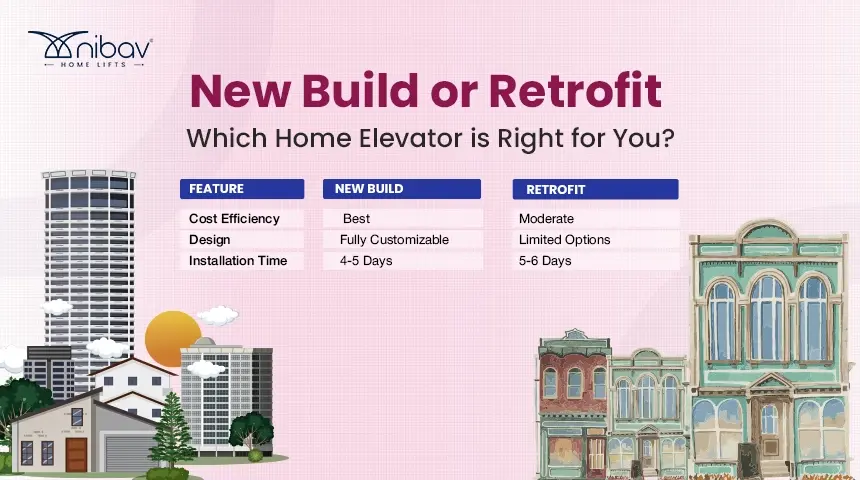
| Factors | Elevator Installation in New Home | Elevator Installation in Existing Home |
| Cost | Lower cost (no renovations needed) | Slightly higher (some adjustments) |
| Design | Full release to customize design | Limited but still adaptable, space allowing with shaftless lifts |
| Civil Works Required | Included in new home construction | Minimal (even modular lifts require no shaft/pit) |
| Installation Timing | Installation takes 4-5 days (should be planned as part of the build) | Installation takes 5-6 working days (may need adjustments depending on the situation) |
| Best For | Families building new homes | Families living in existing multi-story homes |
Things to Think About Before Deciding
Whether you are planning a new build or choosing to retrofit, all home buyers should think about the following items:
- No matter how you look at it, whether you buy a new building or retrofit, expect extra costs to remove one wall or part of a wall. Most plans for an elevator do have modification and re-design factors if you don’t modify walls, but it is best to add in establishment/ design/ modification costs at the beginning of your project.
- Budget – Weigh the one-time expense against the long-term benefits of a home elevator.
- Space – Is there enough space to install a home elevator in your existing home, or can space be allocated if you are constructing a new home?
- Timeline – Will you require the elevator right away, or can you manage until your new build is complete?
- Family Requirements – Seniors, children, or families with accessibility requirements may need delivery sooner rather than later.
- Future Re-Sale Value – An elevator increases the value of your property regardless of when you install it.
Why Nibav Elevators Are the Best Choice for Both New Builds and Existing Homes
Whether you are adding a home elevator during a new build or retrofitting your elevator in an existing home, Nibav offers specific products for American families from which to choose:
- Modular & Shaftless Design – No pit, no machine room, and very small footprint.
- Quick installment – Completed within 4-5 working days.
- Safety Certification – Safety certification to ISO and TÜV NORD standards
- Energy Efficient – Uses power when going up; descends via gravity, uses no power
- Aesthetically Pleasing – Glass cabins, Italian finishes, picturesque views
- Low Maintenance Costs – No oils, no pulleys, no wear, or heavy service requirements.
With Nibav, you won’t have to make the choice between comfort and convenience; you can have it all, whether your home is new or 30 years old.
Conclusion – Timing is Important, but Consistency is Key to Quality
Whether you choose to install a residential elevator during new construction or apply the elevator as a retrofit in an existing home is dictated by your timeline, budget, and specific family considerations.
- For a new build, by integrating your elevator early, you will have lower costs, better designs, and long-term value.
- Early identification of modern, aesthetically tasteful shaftless retrofit elevators allows you to engage the conveniences, accessibility, comforts, and safety without great interruption or renovations.
In the end, your most significant decision should be choosing a safe, reliable, and high-quality elevator system that meets the quality and design standards provided in your historic home or new residence.
Homeowners in the United States can enjoy affordable and sophisticated technology, energy-efficient use, and international safety certifications. Infusing elegance into the creation of your ideal home or new, affordable, and comfortable residence, the installation of a home elevator is one of the best investments to secure a comfortable future in more ways than you can calculate.
Get in touch with our home elevator experts now and experience your home with a whole new level of luxury and comfort.
Talk to Our Experts
Gopal Manwani
This article really breaks down something homeowners often overlook, timing! We’re currently building our forever home, and adding a home elevator during construction now feels like a no-brainer. The long-term accessibility and property value benefits easily outweigh the short-term cost.
Nancy Cannon
Great insights here! I love how you highlighted that home elevators are no longer just for luxury estates. My parents recently retrofitted a Nibav elevator, and it completely changed their mobility and safety. It’s compact, energy-efficient, and surprisingly affordable. Definitely worth considering.
Jim kaeb
I’ve been researching home elevators for months, and this is the first article that actually compares new construction vs. retrofit in detail. I didn’t realize modern vacuum elevators don’t even need a pit or shaft! That makes adding one to our 20-year-old home much more realistic and appealing.
Damiane Murphy
Excellent post! I completely agree that timing is everything when it comes to adding an elevator. For families like ours with young kids and aging parents, installing one during construction is ideal. It’s also impressive that Nibav elevators can be installed in just a few working days!
Millie jones
This is exactly the kind of info homeowners need before committing to an elevator project. The side-by-side comparison was super clear. Retrofitting seemed daunting before, but knowing it only takes about 4–5 days and doesn’t require major structural changes is really encouraging.
Ray Mendoza
Living in a city townhouse, space is always an issue. I liked that the article mentioned shaftless and compact designs for smaller homes. The convenience factor for carrying groceries or luggage upstairs really hit home for me. Definitely adding this to my renovation plans!