
Table of Contents
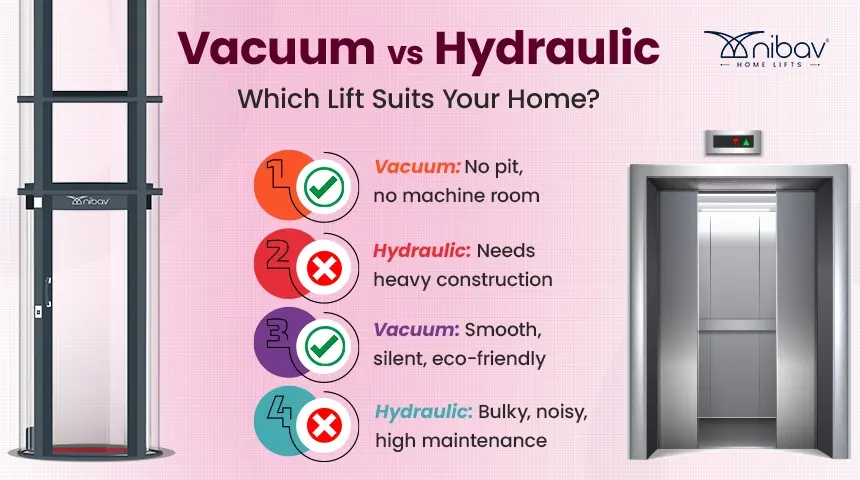
Modern homes that require energy-efficient, small, and simple-to-install solutions are best suited for vacuum lifts, while larger homes that require smoother travel and a greater weight capacity are better suited for hydraulic lifts. Choose according to budget, usage, and available space.
So, when it comes to vacuum lifts vs. hydraulic lifts, which is the best choice for your home? Well, you’re about to find out.
In this comprehensive blog, we’ll walk you through everything from how these lifts work to what they feel like, how they look in your home, and what your decision is about. Whether you’re designing your dream home or retrofitting, Nibav Lifts in the USA is here to help you elevate the right way.
The Evolution of Home Elevators—A Look at How Far We’ve Come
Home elevators used to be seen as a luxury for the ultra-rich or a necessity for those with mobility issues. But in 2026, they’re something more: a symbol of convenience, independence, and style. With space-saving innovations and energy-efficient tech now widely available, today’s homeowners are embracing in-home lifts like never before. But that brings us to a classic elevator face-off:
Vacuum lifts vs hydraulic lifts: Which is the best choice for your home?
| Category | Vacuum Lifts (Pneumatic Lifts) | Hydraulic Lifts |
| How They Work | These are the sleek, transparent tubes you’ve probably seen on luxury home videos. Powered by air pressure, vacuum lifts don’t rely on cables, pulleys, or oil. Instead, they use a vacuum pump that literally “pulls” the lift car upward and lets it gently descend using gravity. Sounds like magic? It’s just physics—beautiful, silent, elegant physics. | Now meet the traditional workhorse. Hydraulic lifts use pistons powered by hydraulic fluid to push the elevator up from below. You’ll need a machine room and a pit to house the components. Think solid, sturdy, but also bulky, noisy, and a bit oily. |
| Installation Requirements | – No pit
– No machine room – No messy civil work – Installation in just 3–4 working days – Perfect for both new constructions and retrofits | – Pit required (8–12 inches)
– Separate machine room – Concrete and civil work – Permits and a high renovation budget are needed |
| Aesthetic Appeal | 360° panoramic glass design, compact and modern. Blends with interiors like art. It can be placed in corners, staircases, or the center of the living space. | Boxed-in design, usually hidden inside a shaft. Built for function, not looks. Requires an enclosure that increases cost and footprint. |
| Space Efficiency | Compact and self-supporting. The smallest model fits within a 3.3 ft diameter. No digging, drilling, or layout changes needed. | Requires a pit, overhead clearance, machine room, and shaft space. Occupies significant home space. |
| Safety & Emergency Response | – No cables or pulleys = no free-fall risk
– Automatic descent to ground during power failure – Emergency ventilation and backup options – Child-safe & elder-friendly controls | – Manual emergency lowering (needs trained help)
– Risk of grease leakage or overheating – More moving parts = higher failure chance |
| Maintenance Requirements | Minimal parts = minimal upkeep.
– No grease or oil – No heavy wear – Just 2 annual maintenance visits – No pit issues | Regular upkeep is needed.
– Oil top-ups & replacements – Seals, pistons, and valves need monitoring – Quarterly checkups recommended |
| Ride Quality & Comfort | Whisper-quiet operation, smooth ascent & descent. No jerks or vibrations. Premium models offer Eco, Comfort, and Fast ride modes. | Slight hum during movement, jerks on stops. Slower acceleration and deceleration compared to vacuum lifts. |
| Energy Efficiency | – Uses electricity only while ascending
– Gravity powers descent – No oil or waste – Eco-friendly with lower operating costs | – Requires power for both ascent and descent
– Oil-based system, environmentally harmful – Higher energy consumption overall |
| Cost & Value | – Slightly higher base price
– Lower installation/civil costs – Minimal lifetime maintenance – Higher resale value – Adds luxury & aesthetic appeal to property | – Sometimes lower upfront cost
– Hidden costs: pit, machine room, civil work, regular maintenance – Adds little or no aesthetic value |
Real-World Applications and User Types
- Young Families: Choose vacuum lifts for safety and easy access between floors
- Elderly Couples: Prefer vacuum lifts for compactness, ease of use, and no renovation fuss
- Luxury Homeowners: Love the visual appeal of panoramic cabins
- Compact Homes and Duplexes: Go with vacuum lifts for minimal space requirements
- Builders & Designers: Recommend Nibav USA’s vacuum models for quick installs and high-end finishes
What Sets Nibav USA Apart as a Leading Vacuum Lift Provider
- Certified under European safety standards
- Installed in over 12,000 homes worldwide
- Dedicated customer support in every U.S. state
- Offers Series IV Standard, Max, III Standard, and Max models for different home sizes
- Transparent pricing, zero hidden fees
- Installation in 4–5 days, with zero structural damage
Elevate Smart, Live Better
So now that you’ve read through the facts, felt the vibes, and imagined the ride—it’s time to decide.
Ready to Take the Next Step?
Contact Nibav USA today for a free consultation, custom quote, or a virtual showroom tour. Your dream home isn’t complete until it moves the way you do, elevated, elegant, and effortless.
Get in touch with our home elevator experts now and experience your home with a whole new level of luxury and comfort.
Talk to Our Experts
Billy Pyatt
I’ve been researching home elevators for a while, and this is by far the most detailed and practical breakdown I’ve found. The pros and cons of vacuum vs hydraulic lifts are well explained. I had no idea vacuum lifts were that quick to install. Great info for U.S. homeowners looking to upgrade!
Carlos Morales
This blog really helped me understand the difference between vacuum and hydraulic lifts! I was confused about which one to choose for my home renovation, but the comparison chart made it so clear. I love how energy-efficient and stylish the vacuum lift looks; I'm definitely leaning toward Nibav now!
Filomena Gomes
This article answered all my questions about home elevators in one go. The section on space efficiency and aesthetics really stood out. I love the panoramic look of vacuum lifts, and it’s awesome that Nibav offers models for different home sizes. Great content for modern homeowners!
Jesse Malone
As a U.S. interior designer, I found this blog incredibly useful. Clients often ask me about elevator options, and your side-by-side comparison of vacuum vs hydraulic lifts makes it so easy to explain. The quick installation and zero civil work are huge advantages for remodel projects!
Truman
This blog was such a great read! It’s clear and easy to understand, even for someone new to home elevators. The vacuum lift’s energy efficiency and modern design make it a top choice for compact homes. Thanks to Nibav USA for helping homeowners elevate in a sustainable way.
Nancy Monis
I never realized how far home elevator technology has come until I read this. The part about vacuum lifts using air pressure instead of cables was fascinating! Love that they’re safe, quiet, and eco-friendly. Definitely bookmarking this for when I build my new home next year.
Bobby Hedi
This blog post really stood out for its clarity and helpful visuals. It’s great that you mentioned both the technical aspects and lifestyle benefits. Vacuum lifts seem perfect for modern U.S. homes that value design and efficiency. Definitely recommending this article to friends!