
Table of Contents
- Introduction: Which Option is Safer for Seniors in 2026?
- Why Safety is the #1 Priority for Seniors
- How Home Elevators Operate & Their Safety Features
- How Staircase Chair Lifts Work & Their Safety Features
- Typical Safety Features Include:
- Comparing Costs: Home Elevators vs Staircase Chair Lifts
- Additional Cost Considerations:
- Ease of Use & Accessibility for Seniors
- Maintenance & Reliability Considerations
- Case Studies & Real-Life Experiences
- Conclusion: Which Is Safer for Seniors in 2026?
- Ready to Choose the Safest Mobility Solution?
In 2026, home elevators and staircase chair lifts both enhance senior mobility, but elevators offer greater safety, comfort, and future-proofing. While chair lifts suit smaller budgets and spaces, elevators reduce fall risks, support wheelchairs, and blend seamlessly into homes—making them the safer, long-term choice for seniors seeking independence.
Introduction: Which Option is Safer for Seniors in 2026?
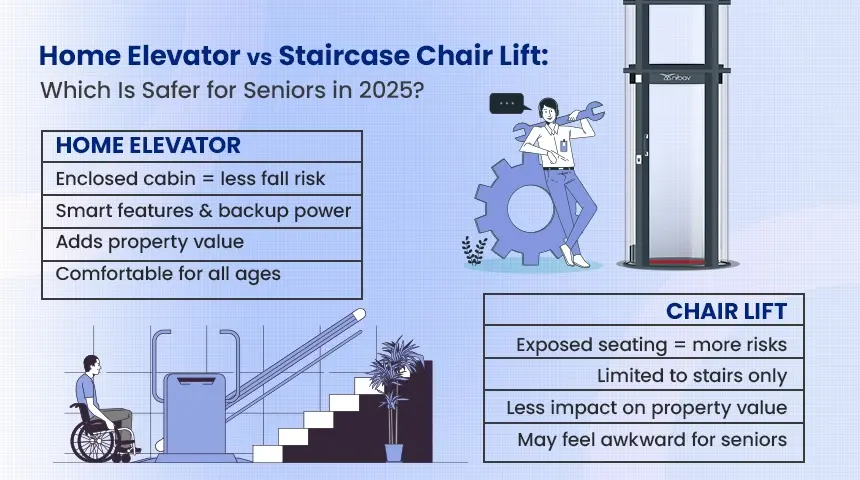
If you are exploring a safe solution for seniors in 2026, it is clear that home elevators are a safer and more reliable solution than chairlifts. But why are home elevators safer? Safety features such as automatic door sensors, emergency braking, and backup power systems significantly lower the chances of falls or sudden halting in comparison to chairlifts, which have minimal safety features and rely on the seniors’ ability to sit, hook on, and detach. In this blog, we will examine the safety features, cost, usability, and maintenance of each decision that helps give families the best information to make decisions for seniors.
Why Safety is the #1 Priority for Seniors
When selecting mobility devices for older adults, there will always be a primary concern: safety. Falls are one of the leading causes of injury in older adults, which makes risks become exponentially worse when injuries occur on stairs. In fact, according to the CDC, there are thousands of serious stair-related injuries every year in the United States, many of which result in hospitalization and extended recovery.
To address these issues, in 2026, there were new advancements and safety standards in home mobility products that were introduced. Families want products to mitigate their loved one’s risk of hazards while promoting independence and comfort.
Home elevators and stairway chair lifts can both mitigate risk while traveling between levels of your home. The question becomes, which one is better at reducing risk than the other? Understanding the safety features and limitations of the devices should allow someone to make a more informed decision.
How Home Elevators Operate & Their Safety Features
Home elevators can come in a variety of designs—pneumatic, cable-driven, or hydraulic—all of which have been created to carry people safely and smoothly from floor to floor with ease of use.
The Main Safety Features:
- Automatic Door Sensors: This feature occurs if the door is not closed fully or if something is blocking the path of the door motion. It stops the elevator from moving to avoid possible accidents, such as fingers or mobility aids getting caught.
- Emergency Braking Systems: Halting the movement safely if the elevator detects a malfunction or it loses power. High-quality home elevators have a braking system that engages automatically to keep the elevator from abruptly falling.
- Backup Power Supply: Power outages can be dangerous. If an elevator stops mid-floor because of a power failure, it can expose occupants to various dangers. Many elevators have emergency power battery backup to lower riders to the nearest floor or contact emergency services.
- Smooth Start and Stop Technology: An important design distinction of these product categories. Jerking may throw someone off balance or create discomfort. This is especially important for seniors with mobility or balance issues.
- Weight Sensors: A safety mechanism functioning like a fault detection device to recognize if the total load exceeds safe limits, in order to protect the elevator from damage/breakdown that may expose riders to other dangerous situations.
These features, combined with easy-to-use control panels designed for seniors, make home elevators a highly secure option.
How Staircase Chair Lifts Work & Their Safety Features
Staircase chair lifts are motorized seats that move along rails attached to the staircase. They are often seen as a quick, lower-cost alternative to elevators.
Typical Safety Features Include:
- Seat Belts: To keep users securely seated during transit.
- Obstruction Sensors: Stop the lift if something blocks the track.
- Swivel Seats: Allow seniors to safely get on and off facing away from the stairs.
- Smooth Start/Stop Controls: Reduce jolting or jerky movement.
However, the safety of a staircase chair lift heavily depends on the user’s physical ability to sit properly, operate controls, and maintain balance during transit. For seniors with limited upper-body strength or cognitive impairments, this can pose challenges.
Also, unlike elevators, chairlifts lack automatic doors, meaning the user must carefully navigate entering and exiting, increasing the risk of slips or falls.
Potential Concerns:
- Difficulty getting on/off if the user has severe mobility limitations.
- Risk of injury if the seat belt isn’t fastened properly.
- Exposure to stairs during entry/exit poses an ongoing fall risk.
Comparing Costs: Home Elevators vs Staircase Chair Lifts
Cost is a major factor for many families when choosing between these options.
- Staircase Chair Lifts: Typically range from $10,000 to $30,000, depending on stair length and customization. Installation is often quick and less invasive.
- Home Elevators: Costs vary widely—pneumatic elevators usually start around $50,600, depending on size, design, and features.
Additional Cost Considerations:
- Installation: Chair lifts require rail mounting on stairs; elevators need structural modifications like shaft construction.
- Maintenance: Elevators usually require more professional maintenance but tend to have longer lifespans.
- Resale Value: Elevators often add more value to your home, which can offset initial expenses.
Example: The Smith family in Ohio initially opted for a chair lift due to budget constraints, but later upgraded to a home elevator for better long-term safety and convenience.
Ease of Use & Accessibility for Seniors
Ease of use is just as important as safety.
- Home Elevators: Require minimal physical effort. Most feature simple button controls or even voice activation. The spacious cabin allows seniors to enter with walkers or wheelchairs easily.
- Staircase Chair Lifts: Require users to transfer onto the seat, fasten seat belts, and operate the joystick or buttons. This can be tricky for seniors with limited dexterity, arthritis, or cognitive challenges.
Space also matters—elevators take more room but allow for versatile mobility, while chair lifts can crowd narrow staircases and may block stairs when not in use.
Maintenance & Reliability Considerations
Regular upkeep keeps both lifts safe and functional.
- Home Elevators: Require scheduled professional servicing every 6 months to check cables, brakes, sensors, and control systems. House elevators might have fewer moving parts, but still need seal and pressure checks.
- Chair Lifts: Generally simpler but still need annual service for the motor, rail, and safety sensors. Battery backups, if available, should be tested regularly.
Reliability affects safety: unexpected breakdowns can trap seniors or lead to falls if the chair stops mid-staircase. Choosing a provider with local, reliable service is crucial—especially in the USA, where regional service networks matter.
Case Studies & Real-Life Experiences
Case 1: A 78-year-old in California chose a home elevator after a bad fall on stairs. “The elevator has changed my life—I don’t have to worry about balance or holding onto rails anymore.”
Case 2: An 85-year-old in Florida uses a chair lift but needs assistance getting on and off daily. “It’s affordable, but I wish it felt safer and easier to use by myself.”
Conclusion: Which Is Safer for Seniors in 2026?
For 2026 and beyond, home elevators provide the best safety and ease of use for seniors, safety, comfort, and independence, especially for seniors with limited mobility and health issues. Home elevators have the most advanced safety features; their smooth operation and professional maintenance provide peace of mind that stairs cannot.
Staircase chair lifts may be good for active seniors on a budget, but they also have an element of risk because they rely upon the user’s ability and supervision. If safety, comfort, and independence are your main priorities, purchasing a home elevator may be a wiser decision.
Ready to Choose the Safest Mobility Solution?
Get in touch with Nibav USA today to discuss the best home elevator for your specific needs. Our team is happy to help you find a safe, stylish, and cost-effective solution for your loved ones to continue living life with confidence in their mobility.
Get in touch with our home elevator experts now and experience your home with a whole new level of luxury and comfort.
Talk to Our Experts
Jose P
This article really opened my eyes! I’ve been comparing home elevators and stair lifts for my parents, and your breakdown makes perfect sense. The elevator’s safety features, like backup power and automatic sensors, sound far more reliable for seniors. Thanks for making the decision easier for our family.
Joanne Lee
We installed a Nibav home elevator for my dad last year, and it’s been a game-changer. He feels independent again without worrying about the stairs. The smooth ride and automatic safety locks are exactly as described here. Great to see a blog that clearly explains why elevators are worth it long-term!
Gary Wilson
My grandmother uses a chair lift, and while it helps, she still struggles getting on and off. After reading this, I’m convinced a home elevator would be a safer option. The emergency braking and power backup features seem essential for seniors living alone. Really helpful and practical read!
MARK DANIEL
This blog provides an excellent comparison of home elevators versus stair lifts from a safety standpoint. The mention of weight sensors, smooth stop systems, and accessibility features shows real attention to detail. It’s great to see updated 2025 data for families making this important decision.
Nick Brown
I appreciate this detailed comparison; it’s refreshing to find a post focused on safety first. Many seniors in our USA community are exploring mobility options, and your article gives clear, practical guidance. Elevators really do seem like the future of safe home accessibility in 2025.
Gloria Vargas
Great comparison! We recently installed a home elevator after realizing our old stair lift wasn’t enough for my mom’s mobility needs. The smooth ride and automatic sensors make such a difference. I completely agree that home elevators are the safer, future-ready choice for seniors today.