
Table of Contents
- The Rise of the Home Elevator
- Not All Elevators Are Created Equal
Have you ever wanted to just glide effortlessly from floor to floor, bypassing an impossibly long flight of stairs or waiting for an elevator? What if the elevator in your home became a compelling focal point, not just an elevator?
By 2026, elevators will no longer be for the wealthy, the stars of Your Favorite Show, or the 50th floor of a skyscraper. Elevators are becoming a commonplace feature of everyday architecture in America, from modern family homes to heritage townhouses and coastal villas. However, not all elevators are created equal. Choosing the right elevator could mean the difference between an expensive renovation hassle and a personal home transformation.
So if you’ve been asking, “What are the best elevator types in the USA?” or “What is the best elevator for my building?” You’ve come to the right place. This guide will take you through the best elevator types in the USA to consider for your building, while highlighting a leader in residential lifts, Nibav USA and their vacuum line of home elevators.
The Rise of the Home Elevator
Before we get technical, let’s start with a simple truth: your home should evolve with you. Whether you’re a homeowner planning to age in place, a parent making your space safer for children and grandparents, or a design lover chasing the ultimate luxury elevators make life easier and more elegant.
Here’s why more Americans are opting for home elevators:
- To eliminate stairs and reduce accidents
- To make homes accessible for seniors and differently-abled family members
- To future-proof properties without compromising style
- To increase property value in an increasingly competitive market
Now the real question is, what kind of elevator is right for you?
Not All Elevators Are Created Equal
The world of elevators is surprisingly vast. From grease-powered hydraulic giants to silent air-powered lifts, there’s a model for every home—but understanding the differences is crucial.
Let’s break down the most popular types of elevators in the USA, complete with pros, cons, and use cases.
Machine Room-Less Elevators – The Smart Space-Saver
A modern twist on traction elevators, MRLs hide the motor inside the shaft, eliminating the need for a separate machine room.
Why Choose It:
- Saves significant space
- Reduces construction costs
- More energy-efficient
Considerations:
- Not ideal for heavier loads
- Limited travel height
- Requires skilled maintenance
Best for modern homes and compact commercial buildings.
Vacuum Elevators – The Airborne Marvel
Here’s where innovation takes center stage. Vacuum elevators, like the ones offered by Nibav USA, use air pressure and gravity to move the cabin. No ropes, no fluids—just the power of physics.
Why Choose It:
- No pit or machine room required
- Panoramic glass design enhances home aesthetics
- Installed in just 4 to 5 days
- Minimal power usage
- Ideal for retrofitting existing homes
- Safe, smooth, and silent operation
Considerations:
- Typically limited to low-rise homes (up to 4 stops)
- The cabin size fits up to 2 or 3 people at a time
A perfect fit for luxury homes, smart homes, and stylish renovations.
Why Nibav USA is Changing the Elevator Game
Imagine stepping into a circular glass cabin in your living room. The sunlight filters through as the elevator glides up, soundless and smooth. No cables. No grease. Just clean air propelling you upward.
That’s the experience Nibav USA delivers.
Nibav’s elevators are built specifically for homes, not adapted from commercial tech. They combine Italian design elegance, German precision engineering, and eco-conscious innovation to bring a new level of comfort and style into American households.
A. Built for Homeowners
Nibav elevators are:
- Self-supporting
- Lightweight and compact
- Designed for indoor or outdoor use
- Retrofit-friendly (no heavy construction)
Whether your home is newly built or decades old, Nibav can fit right in.
B. Eco-Friendly Innovation
Unlike traditional elevators, Nibav elevators:
- Use air pressure instead of grease or cables
- Consume electricity only during ascent
- Use gravity and air pressure for descent
- Require no lubrication or harmful fluids
They are one of the most environmentally sustainable elevator options for homes available in the USA today.
C. Prioritizing Safety
Safety isn’t just an add-on feature—it’s a guarantee with Nibav USA. Key safety features include:
- Emergency alarm and telephone
- Automatic descent in case of power failure
- Locking mechanisms on every stop
- Advanced air-seal cabin technology
- TUV & CE certification and global safety compliance
D. Aesthetic Appeal
Nibav’s elevators aren’t just safe and smart—they’re also beautiful. With 360-degree transparent views, modern cabin lighting, and customizable finishes, they add architectural value to any home.
Top Models from Nibav USA
Each model caters to different needs, yet all are designed to make life better, safer, and smarter.
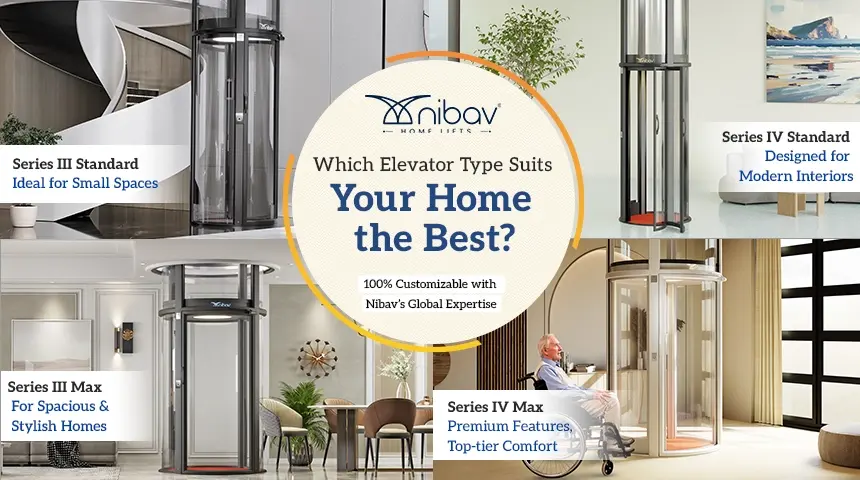
1. Series III Standard
Compact and efficient. Ideal for G+1 or G+2 homes. A perfect starting point for modern mobility.
2. Series III Max
Maintains a compact footprint while offering more cabin space for added comfort.
3. Series IV Standard
Enhanced cabin height, improved ventilation, and smoother ride technology. A premium mid-tier option.
4. Series IV Max
Flagship model with advanced design upgrades, offering unmatched elegance and comfort.
All models are designed for silent travel, energy efficiency, and easy installation.
How to Choose the Right Elevator for Your Building
Here’s a quick comparison to help you decide between traditional elevators and Nibav’s vacuum elevators:
| Feature | Traditional Elevators | Nibav Vacuum Elevators |
| Space Required | High | Very Low |
| Installation Time | Weeks to Months | 4–5 Days |
| Civil Work | Extensive | Minimal |
| Energy Use | High | Low |
| Aesthetics | Customizable | Panoramic Glass Cabin |
| Maintenance | Regular, Technical | Minimal |
| Retrofitting | Difficult | Simple |
| Eco-Friendliness | Low | High |
If your priorities include aesthetics, safety, space efficiency, sustainability, and quick installation, Nibav USA delivers on all fronts.
Common Elevator Myths Debunked
Myth: Elevators are only for people with mobility issues.
Truth: Elevators offer daily convenience for everyone—carrying laundry, groceries, children, or even just avoiding knee strain after a long day.
Myth: Elevators ruin a home’s aesthetics.
Truth: Modern models like Nibav’s are designed to enhance interiors with their sleek, transparent structure.
Myth: Elevators are too expensive.
Truth: With prices starting at around $53,000 and no hidden construction costs, vacuum elevators are an affordable luxury that pays off in convenience and resale value.
Myth: Elevators can’t be installed in existing homes.
Truth: Nibav’s models are tailor-made for retrofits. No pit. No shaft. No hassle.
Why Now is the Perfect Time to Invest
The modern homeowner doesn’t just want function—they want beauty, sustainability, and control. Whether you’re building from scratch or looking to upgrade, installing a home elevator today means:
- Greater independence for seniors and mobility-impaired individuals
- Increased home value and future resale advantage
- Smarter energy use with sustainable technology
- A design-forward lifestyle that combines elegance with ease
Nibav USA is uniquely positioned to meet these evolving needs by offering the most advanced elevator options for homes in the USA.
Ready to Rise?
Your home deserves more than stairs. It deserves freedom, safety, and elegance. Whether you live in a duplex, a beachside villa, a penthouse, or a charming townhome, Nibav USA has an elevator that fits your lifestyle and elevates your experience.
Let your next home upgrade defy gravity. Contact Nibav USA today to explore our Series III and Series IV models, request a consultation, and get ready to elevate your lifestyle—one effortless ride at a time.
Get in touch with our home elevator experts now and experience your home with a whole new level of luxury and comfort.
Talk to Our Experts
Rayan
This was an incredibly helpful breakdown of elevator types for modern buildings. I’ve been researching different types of residential elevators, and this guide made it easy to understand what actually works for homes versus commercial spaces. The comparison of traditional systems with vacuum technology really clarified which elevators are best for buildings today.
Colby
I appreciate how clearly this article explains different types of elevators without getting overly technical. As a homeowner exploring types of home elevators, the vacuum elevator section really stood out. It’s great to see modern elevator types that focus on design, safety, and efficiency instead of just function.
Eliel
If someone is trying to understand the best elevators for buildings, this article is a must-read. The way it compares machine room-less systems with vacuum elevators makes the decision process much easier. I especially liked how it focused on real-life use cases for different types of residential elevators.
Krew
I’ve been researching different types of elevators for homes, and this guide answered questions I didn’t even know I had. The explanation of vacuum elevators and why they work well for retrofits was especially helpful. Definitely one of the most practical articles I’ve read on elevator types.
Kenzo
Excellent breakdown of elevator types for residential buildings. Many blogs talk vaguely about lifts, but this one clearly explains the pros and cons of different types of home elevators. It’s helpful to see installation time, energy use, and aesthetics discussed in one place.
Anakin
This guide is perfect for homeowners who want clarity on different types of elevators before making a big investment. The focus on safety, sustainability, and installation makes it easier to choose the best elevators for buildings that aren’t high-rises.
Gerardo
I’ve read many articles on types of lifts for home use, but this one stands out for its depth and clarity. The way it explains how vacuum elevators work using air pressure is simple yet informative. A great resource for anyone comparing elevator types.
Keegan
Very informative article on different types of elevators for residential buildings. I liked how it addressed common myths and real concerns homeowners have. This is especially useful for people exploring types of home elevators for existing houses.